Stan Lee’s Legacy: How One Man Humanized Superheroes and Changed the World

🌟 The Man Behind the Marvels: Stan Lee Journey from Stanley Lieber to Comic Book God

Stan Lee

Stan Lee wasn’t just a name—it was a seismic force that reshaped pop culture. For millions, he symbolized the boundless imagination that birthed Spider-Man, the X-Men, and Black Panther. Yet behind the cameos, catchphrases, and cosmic storytelling was Stanley Martin Lieber: a Depression-era kid who dreamed of literary greatness but accidentally built a universe where heroes bled, doubted, and triumphed like the rest of us.

🌱 From Stanley Lieber to Stan Lee: The Making of a Mythmaker

Born to Romanian-Jewish immigrants in 1922, Lee’s childhood in Manhattan’s Washington Heights was marked by poverty. His father, a dress cutter, struggled with unemployment during the Great Depression, forcing the family into cramped apartments where Stanley and his brother shared a single bedroom. Books and Errol Flynn films became his refuge—a portal to worlds where heroes defied injustice .

Lee’s talent emerged early. At DeWitt Clinton High School, he won essay contests and devoured classics, nurturing dreams of writing the “Great American Novel.” But at 16, facing financial pressure, he took a job at Timely Comics (later Marvel) through his uncle Robbie Solomon. His duties? Filling inkwells, fetching lunches, and proofreading .

His first published work came in 1941: a Captain America text filler signed “Stan Lee.” The pseudonym—intended to preserve his real name for future literary glory—became his identity. After wartime service in the Army’s Signal Corps (where he wrote manuals alongside Frank Capra and Theodor Geisel), Lee returned to a struggling comics industry . By the 1950s, disillusioned with clichéd superhero tropes, he nearly quit comics entirely .

  • Born: 1922 to Romanian-Jewish immigrants
  • Grew up in: Washington Heights, Manhattan
  • Struggles: Great Depression, cramped apartments
  • Escape: Books and Errol Flynn films
  • Early promise: Essay contests, literary aspirations
  • First job: Timely Comics, age 16 (through uncle Robbie Solomon)
  • First published work: Captain America text filler, signed “Stan Lee”
  • Military service: Army’s Signal Corps, alongside Frank Capra and Theodor Geisel (Dr. Seuss)
  • 1950s disillusionment: Nearly quit comics

💥 The Marvel Revolution: Flawed Gods and Human Heroes

In 1961, Marvel began its Silver Age—transforming superheroes into relatable characters.In 1961, tasked with competing with DC’s Justice League, Lee and artist Jack Kirby defied genre conventions. Their debut team, the Fantastic Four, bickered, faced bankruptcy, and grappled with fame—a radical departure from morally pristine heroes. This sparked Marvel’s “Silver Age,” a creative supernova that redefined comics.

📊 Table: Stan Lee’s Key Co-Creations (1961–1966)

Character/Team Debut Issue Year Key Artist Groundbreaking Trait
Fantastic Four Fantastic Four #1 1961 Jack Kirby Dysfunctional superhero family
Spider-Man Amazing Fantasy #15 1962 Steve Ditko Teen hero with everyday struggles
Hulk Incredible Hulk #1 1962 Jack Kirby Hero/villain duality; PTSD allegory
Iron Man Tales of Suspense #39 1963 Don Heck Wealthy industrialist with heart weakness
X-Men X-Men #1 1963 Jack Kirby Marginalized mutants as civil rights metaphor
Black Panther Fantastic Four #52 1966 Jack Kirby First mainstream Black superhero
Lee’s genius: Humanizing the superhuman
  • Spider-Man: Teen with existential angst
  • Hulk: Atomic-age Jekyll-and-Hyde
  • X-Men: Prejudice and identity themes
  • Serialized narrative: “Illusion of change”

Lee’s genius lay in humanizing the superhuman. Spider-Man (1962) wasn’t a sidekick but a neurotic teen—”bitten by a radioactive spider and by existential angst,” as one critic noted. The Hulk channeled Cold War atomic anxiety into a Jekyll-and-Hyde tragedy. The X-Men became outsiders fighting prejudice. Lee called it “the illusion of change”—serialized storytelling where characters evolved across issues, forging emotional bonds with readers.

⚙️ Stan Lee Marvel Method: Collaboration and Conflict

Stan Lee

“Marvel Method” process:

  1. Lee outlines plot
  2. Artist (Kirby, Ditko) draws
  3. Lee adds dialogue
  • Created iconic visuals like:
    • Galactus saga (Fantastic Four #48)
    • Psychedelic Doctor Strange (Ditko)

Stan Lee Controversy: Artists felt undervalued

“I figured if an adult read one of our comics and saw how literate they were, they’d be hooked.” —Stan Lee

1971 Spider-Man arc: Tackled drug abuse, defied Comics Code Authority, leading to policy reform.

Lee pioneered the “Marvel Method”: he’d outline a plot, artists like Kirby or Ditko would visually interpret it, and Lee add dialogue later. This collaborative engine fuelled unprecedented productivity but sowed tensions. Kirby’s dynamic cosmic vistas (e.g., Fantastic Four #48’s Galactus saga) and Ditko’s psychedelic Doctor Strange sequences were foundational, yet artists often felt under credited .

Lee also challenged industry censorship. In 1971, he published a Spider-Man arc addressing drug abuse—defying the Comics Code Authority—which sparked policy reforms. This paved the way for mature themes, cementing comics as legitimate social commentary.

🌪 Behind the Cape: Triumphs, Tragedies, and Betrayals

Lee’s ascent masked personal and professional storms. His wife Joan, whom he married in 1947, was his emotional anchor, yet his relentless work ethic strained family life. Financially, Marvel’s success rarely trickled down; Lee’s salary was modest until the 1970s when he became Publisher .

  • Wife Joan: Married 1947, Lee’s emotional anchor
  • Financial Struggles: Modest pay until 1970s
  • Legal battles:
    • 1998: Stan Lee Media—collapsed amid fraud
    • 2002: Sued Marvel, won Spider-Man profits
    • 2010s: Accused exploitation by managers

Despite setbacks: remained Marvel’s global ambassador

  • Catchphrase: “Excelsior!”
  • 2008: National Medal of Arts

Through it all, Lee remained Marvel’s ambassador—charming fans with his “Excelsior!” catchphrase and iconic cameos. His 2008 National Medal of Arts validated comics as cultural art.


🏛 Stan Lee Legacy: More Than Just Cameos

Lee’s final years were bittersweet. After Joan’s death in 2017, his health declined, yet he kept creating. He died in 2018, but his ethos endures:

🎬 Cultural Dominance

  • MCU = $30+ billion global gross
  • Lee = Highest-grossing figure in film history

Social Advocacy

  • Black Panther (1966): Pioneered Black representation
  • 2018 film = Cultural landmark

🎓 Education

  • Stan Lee Foundation (2009): Supported literacy and arts

🔍 Conclusion: The Man in the Mirror

Stan Lee’s brilliance wasn’t just creating heroes—it was revealing the hero within the ordinary. His characters’ flaws—Peter Parker’s insecurity, Tony Stark’s arrogance, the X-Men’s otherness—mirrored readers’ struggles. Lee transformed comics from escapist pulp into a mirror held up to society’s anxieties and aspirations.

His life, too, was a tapestry of contradictions: a literary aspirant who found immortality in panels; a collaborator embroiled in disputes; a titan battling personal demons. Yet through every twist, Lee championed hope. As he once declared: “Another mountain to climb? Another river to cross? That’s life. But as long as you’re passionate about what you do, you’ll never work a day in your life.”.

In a universe of gods and monsters, Stan Lee’s greatest superpower was making us believe we could be heroes too—one flawed, human step at a time. Excelsior!

Stan Lee’s brilliance wasn’t just creating heroes—it was revealing the hero within the ordinary.

  • Peter Parker: Insecurity
  • Tony Stark: Arrogance
  • X-Men: Outsider identity

Comics = Mirror of society: Not just pulp, but emotional and social reflection

Lee’s own story:
  • Literary aspirant turned comic legend
  • Collaborator amid disputes
  • Titan facing exploitation and aging

Yet he always championed hope:

“Another mountain to climb? Another river to cross? That’s life. But as long as you’re passionate about what you do, you’ll never work a day in your life.”

🌲 Visual Tree Structure of Article

Stan Lee’s Journey
├── The Making of a Mythmaker
│   └── Early life, education, first jobs
├── The Marvel Revolution
│   ├── Key Creations (1961–1966)
│   └── Humanizing Superheroes
├── The Marvel Method
│   ├── Collaborative approach
│   └── Artist tensions and censorship defiance
├── Behind the Cape
│   ├── Personal life
│   ├── Legal and financial battles
│   └── Public figure and honors
├── Legacy
│   ├── MCU impact
│   ├── Social advocacy
│   ├── Educational work
│   └── Major awards
└── Conclusion
    └── Human struggles, timeless inspiration


Annie Leibovitz: Capturing Icons, Defining an Era of Photography

Annie Leibovitz : Through the Photographer’s Eye

Annie Leibovitz

I. The Alchemy of Intimacy: Crafting Icons from Human Moments

Annie Leibovitz camera functions as both scalpel and paintbrush—dissecting the layered psychology of her subjects while composing visual symphonies that transcend time. When John Lennon curled naked around Yoko Ono on December 8, 1980, Leibovitz captured not just bodies but manifesto of love and vulnerability. Five hours later, Lennon’s assassination transformed that Polaroid into a cultural relic, proving her ability to freeze moments heavy with unspoken futures.

This alchemy defines Leibovitz’s 50-year reign as photography’s premier portraitist. Her lens dissected rock gods, royalty, and rebels, revealing their humanity through radical intimacy. “A thing you see in my pictures,” she reflects,“is that I was not afraid to fall in love with these people.” This emotional courage—paired with
painterly lighting and theatrical staging—redefined celebrity photography as psychological excavation.

II. Annie Leibovitz : From Military Bases to Rock ‘n’ Roll Frontlines (1949–1970)

Annie Leibovitz Early Influences

Born in Waterbury, Connecticut, in 1949,Anna-Lou Leibovitz inherited artistic curiosity from her modern-dancer mother and discipline from her Air Force lieutenant colonel father.Constant relocations—including a pivotal stint in the Philippines—taught her to observe cultures through the outsider’s lens. Her first camera, a
Minolta SRT101 bought in Japan, became her compass:“If I was going to live with this thing, I was going to have to think about what that meant.”

At the San Francisco Art Institute, Leibovitz abandoned painting for photography’s immediacy: “Photography took me outside and helped socialize me… I wanted reality.”Inspired by Robert Frank’s raw documentary style, she shot
anti-war protests—one image landing on a magazine cover, foreshadowing her career.

Year Event Significance
1967 Enters San Francisco Art Institute Shifts from painting to photography
1969 Works on kibbutz in Israel Documents war protests; first published cover
1970 Hired by Rolling Stone Shoots John Lennon; begins defining rock photography

III. Annie Leibovitz Stone Era: Chasing the Zeitgeist (1970–1983)

Annie Leibovitz

Annie Leibovitz – The Crucible of Creativity

Rolling Stone became Leibovitz’s laboratory. At 23, she was named chief photographer, embedding herself with
counterculture icons. Her approach blended reportage with psychological portraiture.

  • Unfiltered Access: She lived with The Rolling Stones for their 1975 tour, capturing backstage exhaustion and onstage frenzy. The hedonism cost her dearly—she battled cocaine addiction afterward.
  • The Set-Up Portrait: Moving beyond candid shots, she staged conceptual images like Bette Middler nude on roses, merging vulnerability with artifice.

The Lennon-Ono session epitomized her method. When Yoko refused nudity, Leibovitz improvised: “Leave everything on.” The result—Lennon’s fetal embrace of Yoko—felt, in his words, “exactly like our relationship.”

IV. Annie Leibovitz : Theatrical Storytelling (1983–Present)

Annie Leibovitz Reinventing Glamour

Joining Vanity Fair’s relaunch, Leibovitz traded rock grit for high-gloss narrative: “I wanted to learn about glamour.” Her toolkit evolved:

  • Cinematic Lighting: Mimicking Rembrandt’s chiaroscuro to sculpt subjects in dramatic shadows.
  • Collaborative Ideation: Working with stylists and subjects to build elaborate tableaux, like Whoopi Goldberg submerged in milk—a visual metaphor for racial identity.
Annie Leibovitz Iconic Images
  1. Demi Moore, Pregnant (1991): Defying Vanity Fair’s request for a headshot, Leibovitz portrayed Moore nude and regal. The cover sparked outrage but dismantled taboos around pregnancy.
  2. Queen Elizabeth II (2007): Leibovitz stripped royal portraiture of pomp, capturing the Queen in tweed against misty moorlands. Palace tensions flared, but the image humanised monarchy.
  3. Caitlyn Jenner (2015): Jenner’s Vanity Fair reveal, shot in a corset and pearls, became a landmark in transgender visibility.

V. Annie Leibovitz Method: Intimacy as Technique

Anatomy of a Photoshoot

Leibovitz’s process is a masterclass in psychological orchestration:

  • Pre-Shoot Immersion: Days researching subjects—reading their work, studying their gestures. For Louise Bourgeois, she visited the sculptor’s studio, capturing her gripping a marble “egg” like a talisman.
  • Rapport Building: Hours of conversation precede the first click. “You must take care of people who open their hearts to you,” she insists.
  • Technical Alchemy: Uses medium-format Hasselblads for depth, primes (50mm, 85mm) for intimacy, and mixes tungsten with natural light for painterly texture.

“I don’t think there’s such a thing as capturing the perfect moment… But you can capture raw moments that are honest.” — Annie Leibovitz

VI. Controversies & Challenges: The Cost of Authenticity

Leibovitz’s pursuit of truth often ignited firestorms:

  • Miley Cyrus (2008): A 15-year-old Cyrus wrapped in satin provoked accusations of exploitation. Leibovitz defended it as “a simple, classic portrait.”
  • LeBron James/Gisele Bündchen (2008): Critics saw racist tropes in the “King Kong”-inspired Vogue cover; others praised its subversion.
  • Financial Struggles: Lavish productions led to near-bankruptcy in 2009, forcing her to mortgage her life’s work. Yet she continued creating, calling photography “a dance with light and weather.”

VII. Legacy: The Humanist with a Hasselblad

Leibovitz’s influence radiates beyond galleries:

  • Cultural Archivist: Her images—from Nixon’s resignation to Obama’s presidency—document America’s psyche.
  • Feminist Icon: Projects like Women (2003) celebrate female strength and complexity.
  • Mentor & Educator: Teaching at Yale, she inspires the next generation of photographers.

VIII. Conclusion: The Eternal Dialogue Between Lens and Soul

Annie Leibovitz’s work is a dialogue—between artist and subject, light and shadow, the fleeting and eternal. She doesn’t just take pictures; she invites us into intimate moments that reveal our collective humanity. As she aptly puts it:

“Photography is a way of feeling, of touching, of loving. What you have caught on film is captured forever… it remembers little things, long after you have forgotten everything.”

Banksy: The Invisible Artist Who Speaks Loud

🌳 Structure Overview

Banksy: The Invisible Artist Who Speaks Loud
│
├── I. The Birth of a Phantom: Origins and Identity
│   ├── A. Bristol’s Unlikely Revolutionary
│   ├── B. The Name, The Myth
│   └── C. Identity Speculation: Red Herrings and Clues
│
├── II. Stencils as Subversion: Artistic Evolution
│   ├── A. Technique: Speed as Rebellion
│   ├── B. Exhibitionism as Critique
│   └── C. The Street as Canvas, The World as Audience
│
├── III. Anonymity: The Ultimate Performance Art
│   ├── A. Practicality and Power
│   └── B. The Art World’s Complicated Dance
│
├── IV. Activism: Art as a Weapon
│   ├── A. Humanitarian Provocations
│   └── B. The "Banksy Effect" on Communities
│
├── V. The Market vs. The Message
│   ├── A. Commercialization and Contradiction
│   └── B. Anonymity’s Economic Shield
│
└── VI. Legacy: The Invisible Revolution

The Paradox of Anonymity in a World Obsessed with Identity

Banksy

In an era defined by digital footprints, celebrity culture, and relentless self-promotion, Banksy stands as a defiant anomaly—an artist whose face remains unknown while his voice echoes globally. His stenciled rats, satirical murals, and subversive installations have transformed urban landscapes into arenas of cultural critique, merging guerrilla tactics with poetic resonance. More than a graffiti artist, Banksy is a cultural philosopher armed with spray paint, leveraging invisibility as both shield and weapon. This exploration dissects the layers of his enigma, the evolution of his craft, and the seismic impact of an artist who proves identity is irrelevant when art speaks truth to power.

I. Banksy The Birth of a Phantom: Origins and Identity

A. Bristol’s Unlikely Revolutionary

Banksy emerged from Bristol’s underground scene in the early 1990s, a city pulsing with trip-hop beats and countercultural energy. Born likely in 1974 as Robin Gunningham (per Mail on Sunday’s investigation), he attended Bristol Cathedral School before expulsion and petty crime led to a formative prison stint. His early work with the DryBreadZ Crew (DBZ) featured freehand graffiti, but a near-arrest under a diesel-leaking truck became a creative epiphany: spotting a stenciled serial number, he realized stencils could slash production time and amplify impact.

B. The Name, The Myth

The alias “Banksy” evolved from “Robin Banx”—a nod to his early “robbing banks” edge—later streamlined for memorability. His first major mural, The Mild Mild West (1999), depicted a teddy bear hurling a Molotov cocktail at riot police in Stokes Croft, Bristol. It announced his signature blend of whimsy and dissent.

C. Identity Speculation: Red Herrings and Clues

Robin Gunningham: Geographic profiling by Queen Mary University linked Banksy’s works to Gunningham’s movements. A 2003 BBC interview caught Banksy confirming his first name as “Robbie”.
Robert Del Naja: The Massive Attack founder, a former graffiti artist, fueled theories by coordinating Banksy-like murals during tour dates. Del Naja denies being Banksy but calls him a “friend”.
Collective Theory: Some argue Banksy is an art collective—a notion amplified by the scale of projects like Dismaland.
Banksy’s own words dismiss the obsession: “I don’t want to take sides. I want to take over.”

II. Banksy Stencils as Subversion: Artistic Evolution

A. Banksy Technique: Speed as Rebellion

Banksy’s switch to stencils was pragmatic: “A tight image in 30 seconds is the way to go.” This efficiency let him target high-surveillance zones—police stations, war zones, museums—while embedding complex narratives:
Rats: Symbols of society’s “powerless losers,” they scrub floors, wield placards (“Welcome to Hell”), or loom over cities like anarchic giants.
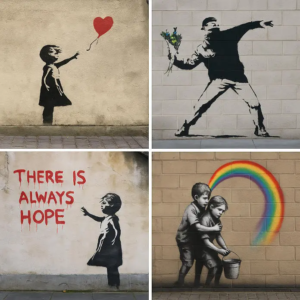
Children and Animals: Innocence weaponized. Girl with Balloon (2002) contrasts hope with loss; Napalm (2004) traps a Vietnamese war victim between Mickey Mouse and Ronald McDonald.

B. Banksy Exhibitionism as Critique

Banksy hijacked traditional art spaces to lampoon their elitism:
Turf War (2003): Live cows spray-painted with Warhol portraits; Queen Elizabeth as a chimp. Animal rights activists chained themselves in protest.
Crude Oils (2005): Monet’s water lilies polluted with shopping carts; 164 live rats infesting a London gallery.
Barely Legal (2006): An elephant painted in “poverty pattern” gold—a jab at inequality. L.A.’s elite partied beside it until authorities ordered the paint removed.

C. The Street as Canvas, The World as Audience

Banksy’s public installations force communal reckoning:
West Bank Wall (2005): Trompe l’oeil holes revealing beaches; a ladder ascending to freedom. Israel’s military called it “vandalism”; Palestinians protected the works.
Valentine’s Day Mascara (2023): A 1950s housewife with a black eye, swinging a man into a real freezer. Domestic violence charities used it to spark dialogue.

III. Anonymity: The Ultimate Performance Art

A. Banksy Practicality and Power

Banksy’s invisibility began as necessity—“graffiti is illegal”—but morphed into conceptual genius. It:
Democratizes Art: Viewers engage the message, not the myth. As he stated, “anonymity is vital because it stops your ego interfering.”
Fuels Mythmaking: A pizza box he discarded sold for $102 on eBay; DNA-laden anchovies became relics.
Enables Risk: Installing Crimewatch UK in Tate Britain required a disguise: floppy hat, scarf, and “fine art courier” confidence.

B. The Art World’s Complicated Dance

Galleries and auction houses profit from his anti-establishment brand:
Sotheby’s Shredding (2018): Girl with Balloon self-destructed post-sale, skyrocketing its value. Banksy filmed bystanders’ shock, captioning it, “The urge to destroy is also a creative urge.”
Market Irony: Works like Kissing Coppers ($575,000) critique authority yet fund the elite. Banksy retorted with a painting of auctioneers titled, “I can’t believe you morons actually buy this shit.”

IV. Banksy Activism: Art as a Weapon

Table: Banksy’s Anti-War Iconography

Artwork Symbolism Context
CND Soldiers (2005) Soldiers painting a peace sign Protesting Iraq War/nuclear arms
Happy Choppers Helicopters tied with pink bows Militarization masked as “gifts”
Mediterranean Sea View (2017) Migrant life vests as seascape Refugee crisis; sold for £2.23M for charity
Borodyanka Mural (2022) Gymnast balancing on rubble Ukraine war resilience

A. Humanitarian Provocations

Bethlehem’s Walled Off Hotel (2017): Rooms overlooking Israel’s separation wall featured “Pillow Fight” (soldier vs protester) and “Jesus with Sniper Dot.” Profits supported Palestinian artists. It closed in 2023 amid escalating violence.
Glastonbury Lifeboat (2024): Inflatable migrant boat dummies crowd-surfed during IDLES’ set—a silent indictment of U.K. refugee policy.

B. The “Banksy Effect” on Communities

When Banksy claims a wall, locals face chaos:
Margate (2023): Valentine’s Day Mascara drew media swarms. The council removed its attached fridge; fans stole the plastic chair.
Lowestoft (2021): Seagull Stealing Chips cost owners £450,000 in preservation fees. Gert, the landlord, fumed: “It’s not a seagull, it’s an albatross!”

V. The Market vs. The Message

A. Commercialization and Contradiction

Banksy’s Pest Control authenticates works but can’t control speculation:
Vandalism as Investment: Murals are chiseled from walls, like Slave Labour (2012), sold for $1.1M after vanishing from London.
Ethical Tensions: Dealer John Brandler notes, “The brand Banksy is so big, anonymity doesn’t matter anymore.” Yet purists like Steph Warren insist street art dies when removed: “Context is everything.”

B. Anonymity’s Economic Shield

By avoiding galleries, Banksy retains control:
Self-Published Books: Wall and Piece sold 250,000+ copies, funding projects sans intermediaries.
Unauthorized Sales: eBay listings of “Banksy dirt” or shredded canvas fragments parody art commodification.

VI. Legacy: The Invisible Revolution

Banksy redefined art’s relationship with power:
Democratizing Access: “You don’t need college or to sleep with someone powerful. Just ideas and broadband.”
Inspiring Global Movements: Ukraine’s “Sharik” and Russia’s anti-war graffiti adopt his stencil style.
Enduring Questions: Does anonymity amplify art’s purity? Or does removing the artist neuter accountability?

In 2024, as his wildlife murals surface in London—a satellite-dish wolf, a car-crushing rhino—the cycle continues: creation, defacement, myth. Banksy remains a cultural paradox: a silent voice that deafens, a ghost haunting capitalism’s machine, and proof that in a world screaming for attention, sometimes the loudest statement is made unseen.

“Art should comfort the disturbed and disturb the comfortable.”
— Banksy’s uncredited manifesto, lived in every stroke.

Zaha Hadid architecture design

Zaha Hadid: Shattering Architecture’s Glass Ceiling

Zaha Hadid

Introduction

Zaha Hadid was a force of nature in the field of architecture, a woman whose visionary sensibility and formidable personality have reshaped skylines and redrawn the boundaries of buildings. Born in Baghdad in 1950, she rose to prominence in a profession long men dominated and was for award- the Pritzker Architecture Prize in 2004, the first woman to receive it. This blog explores her extraordinary life, her pioneering contributions, and the lasting impact she made.

Early Life and Education

The Formative Years

Zaha Hadid came from an illustrious family in Iraq. Her father, Mohammed Hadid, was a powerful politician and industrialist, and her mother, an artist. With her liberal, intellectual upbringing, Hadid got expose to multiple fields and thoughts. She spent much of her childhood traveling and attending Catholic schools in Iraq and Switzerland, forging a global perspective early in life.

Architect with the interest in :Architecture Studies in London

Zaha Hadid arrived in London in the 1970s to study at the Architectural Association School of Architecture. It was a transformative time at the AA. Under the influence of avant-garde architects Rem Koolhaas and Elia Zenghelis, Hadid developed an audacious, experimental style. Her thesis project, “Malevich’s Tektonik”, was an homage to the Russian Constructivists and a hint of her work to come — straying into radical geometry and abstraction while incorporating movement.

An Early And Difficult Career

Establishing Her Own Firm

In 1980, Hadid established her own London based architecture office, Zaha Hadid Architects (ZHA). The firm confronted various obstacles, not the least of which was the reluctance of the architectural world to accept a female-led practice whose designs were highly conceptual. Many of her early commissions went unbuilt, leading to her being known as a “paper architect.”

The Turning Point

Architectural breakthrough For Hadid, that building got completion in 1993, the Vitra Fire Station in Weil am Rhein, Germany. It was small in scope, but was a step toward converting her abstract images into reality. A sculptural composition of sharp angles and dynamic planes, it heralded Hadid’s move from idea to building.

Breaking Through: Major Works

MAXXI Museum, Rome

Hadid’s fluid architectural vocabulary made in projects like the MAXXI – Museum of 21st Century Arts in Rome, which was completed in 2009. The building blurs the distinctions between inside and outside, a meandering concrete shape with intersecting pathways that invites exploration and interaction. It won the Stirling Prize in 2010.

Guangzhou Opera House

Twin pebbles on the riverbank is how the Chinese Guangzhou Opera House, which opened in 2010 and described. Its form and geometry serves to improve acoustics and enable an engaging spectator experience, weaving within the urban framework of the city. It became a symbol for China’s cultural aspirations.

London Aquatics Centre

It is perhaps her best known public work in the UK and known to built for the 2012 Olympic Games, the London Aquatics Centre. The roof’s cascading curves are meant to create the sensation of the movement of water, a fitting metaphor for the mission of the building. The design was loud for its architectural and operational efficiency.

Other Notable Projects

Heydar Aliyev Center (Baku, Azerbaijan)

The building’s undulating, wave-like design has made it a tour de force of contemporary architecture.

Dongdaemun Design Plaza (Seoul, South Korea)

A futuristic urban development designed for public space, retail and exhibition.

Galaxy SOHO (Beijing)

A commercial structure of interlocking, fluid forms, and a clear demonstration of Hadid’s philosophy regarding fluidity of space.

Overcoming the Gender Barrier

Zaha Hadid

A Male-Dominated Field

Architecture has always been a boys club. While women in architectural education were on the rise, the same could not be said for leadership and prestigious commissions. Hadid’s ascent was itself an affront to those norms.

Paving the Way for Others

In 2004, her being awarded the Pritzker Prize was a watershed not just for her career but for women in architecture in general. Hadid frequently described her hardships as a woman for being from the Middle East in a male and Western-dominated field. She is the one of the woman architects who encouraged a whole lot of other women to take-up architecture with their heads up high.

Philosophy and Design Ethos

Deconstructivism and Fluidity

Hadid’s work has been deemed deconstructivist, referring to a type of design that scorns traditional rectilinear forms. Her buildings are dynamic, fluid, and appear to be in motion. She spurned the orthodoxy of the grid and embraced a visual language that valued complexity.

The Role of Technology

In the vanguard in its use of digital technology, Hadid’s firm employed advanced computer modeling to achieve its sinuous forms. Her parametric designs gave rise to buildings with nature-inspired shapes and structural behaviors never seen before, revolutionizing the field of engineering and construction methods.

Art, Mathematics, and Nature

Her influences were many and varied: Russian Suprematism, Islamic calligraphy, natural topographies, mathematical patterns. Her work frequently has the look of formations in nature — rivers, dunes and coral reefs — but is determinedly future-forward.

Legacy and Influence

Awards and Accolades

Zaha Hadid’s honors include:

  • Pritzker Architecture Prize (2004)
  • Stirling Prize (2010, 2011)
  • RIBA Gold Medal (2016) – the first woman to win it on her own.
  • Dame Commander of the Order of the British Empire (DBE) Honour given for services to international development, overseas exports, and charity causes.

Continued Impact Through ZHA

Zaha Hadid Architects has furthered her legacy since she died in 2016. Under the guidance of Patrik Schumacher the office continues to be a leading protagonist in designing and technology. Recent projects include the Beijing Daxing International Airport and the Al Wakrah Stadium in Qatar.

Impact on Modern Architecture

Her influence spreads beyond her constructed work. She was instrumental in redefining architectural education and theory, and in teaching architects to subvert constraints and upend orthodoxy. Xenophobia Her message is still relevant in advocating for diversity in architecture.

Criticism and Controversy

Design Practicality

Some critics said Hadid’s designs were more about visual excitement than utility. Complex shapes could also result in higher costs and construction difficulties sometimes prevailed. But a lot of her designs have been praised for how well they work after everything is finished.

Labor and Ethics

Hadid also came under scrutiny for accepting work in areas with controversial labor practices, particularly the Gulf. In her own defense, she traced the balance of power between developers and local government, underscoring how little control architects can have over labor conditions.

Personal Life

A Complex Persona

Zaha Hadid had a forceful personality; she was often described as uncompromising and assertive. With high standards and relentless drive, she was both admired and criticized. But closer acquaintances also describe her as warm, funny, loyal.

Artistic Pursuits

Alongside architecture, Hadid also worked on furniture, jewellery and fashion. Her partnership with Chanel, Louis Vuitton and Swarovski were some of her projects fine art collaborations. They were part of her conviction in art and design as fundamentally unified, irrespective of the scale of the work or the discipline.

Conclusion

A Lasting Legacy

Zaha Hadid’s life and output are a testament to the ambition that vision needs to be met with. She made architecture into an art that soars beyond the expected, cheered complexity, movement and, above all, inclusivity. Her legacy is still evident in the world in which we live.

Inspire Future Generations

Hadid’s influence extends well beyond her buildings. She encouraged a generation of architects, especially women and minorities, to take on the establishment. She is a shining light for creative spirit, daring and change.

References and Additional Reading

[1] S. Boztug, V. Reichenberger and J.C. Willems, A note on feedback stabilization for non-square systems Systems Control Lett.

Books

  • ‘Zaha Hadid: Complete Works,’ by Aaron Betsky
  • Zaha Hadid Architects: Redefining Architecture and Design, by Zaha Hadid Architects

Articles

  • Architectural Digest: “Zaha Hadid’s Most Iconic Buildings”
  • Dezeen: “The Riches of Zaha Hadid”

Documentaries

  • “Zaha Hadid: Who Dares Wins” (BBC Documentary)

Hayao Miyazaki the wind rises

Hayao Miyazaki: The Essence of Humanity and Dreams Turned Reality

Hayao Miyazaki

There are few names in animation that inspire as much reverence as Hayao Miyazaki. From hand-drawn magic of My Neighbor Totoro to the ersatz existentialism of Prince Mononoke to the Oscar-winning Spirited Away, Miyazaki’s mastery transcends age, region, and even that which lives within the black lines of the daydream and the dream itself. He doesn’t animate stories so much as dream them into being, providing portals into densely textured worlds that feel a lot like ours but are also a lot more enchanted.

This blog is dedicated to charting Miyazaki’s growth and career as a filmmaker, his themes, aesthetic, philosophies and his never-ending influence from Studio Ghibli.

Hayao Miyazaki: The Origins of a Visionary

Hayao Miyazaki Early Influences 

Miyazaki was born in 1941 in wartime Tokyo and grew up in a Japan that, like much of the rest of the world, was marked by disruption, homelessness and the visceral knowledge of death. These things creep up on you in many of his films, whether it be war-torn devastation or the fragile divide between nature and manmade.

His father was employed by a company that manufactured parts for airplanes, implanting in Miyazaki a lifelong love of flight — a recurring theme in his works, from “Nausicaä of the Valley of the Wind” to “Porco Rosso.”

Hayao Miyazaki From Animator to Auteur

Miyazaki’s animation career started in the 1960s at Toei Animation, where he worked as an in-betweener but soon proved himself as a storyteller. With Isao Takahata, his creative partner and co-founder of Studio Ghibli, he would work on Future Boy Conan, Heidi, Girl of the Alps and more. But it was Nausicaä (1984), based on his own manga, that established his reputation and served as the prologue to Ghibli.

The Films of Studio Ghibli: Hayao Miyazaki

Hayao Miyazaki

A New Chapter in Animation

Founded in 1985, Studio Ghibli emerged from a shared dream to create auteur-driven, high-quality animation in an industry frequently characterized by formula. Under Miyazaki’s leadership, Ghibli would be synonymous with lush hand-drawn worlds, complicated female leads, and moral grayness.

To Exercise Creative Control and Be True to the Art

Unlike many a commercial studio, Ghibli operates more as a film auteur’s atelier than a mass production pipeline. Miyazaki is famously hands-on with every part — from storyboarding to character design to music and editing. He’s a perfectionist: His method may take longer—which explains the long gestation periods between albums or songs. But he consistently produces timeless art.

Themes That Animate the Heart

Environmental consciousness and the Tenuous Balance

One of the most recurring themes in Miyazaki’s movies is his ecological consciousness. In Princess Mononoke, the battle between human industry. Forest spirits is not just about good and evil, but about how to coexist. Nausicaä, too, foresees a world choked by pollution. But where the heroine seeks harmony, not domination.

Hayao Miyazaki : Pacifism and the Cost of War

Miyazaki, a vocal pacifist, includes anti-war themes in numerous of his works. Howl’s Moving Castle, for example, denounces the pointlessness of war with visual panache and emotional nuance. The war is not a glory — it is a lament.

The Other World and the Philosophy of the Shintô Motoworship of the Japanese and Koreans.

Movies like Spirited Away and My Neighbor Totoro offer a Shinto-informed view of the world, in which spirits live in all things, from rivers to soot. This animistic belief gives his stories a spiritual texture, in which children don’t so much navigate fantasy as learn from it.

Strong Female Protagonists

As opposed to many of the mainstream storylines, Miyazaki’s stories are frequently about spirited and self-sufficient young women. Chihiro and (Spirited Away), Kiki and (Kiki’s Delivery Service), and San (Princess Mononoke) stand for resilience, learning, and moral action. They’re not waiting to be rescued — they’re the rescuers.

Crafting the Visual Language

Bringing the digital age to hand-drawn beauty

He has been an insurgent promoting hand-drawn animation in an age of CGI. His films are a visual delight — every frame a painting, each background packed with detail. Whether it’s a castle in the sky that sails across a meadow or a bathhouse teeming with spirits, his images have an organic warmth that digital animation frequently fails to capture.

Miyazaki’s Use of “Ma”—The” Space Between

Among his most praised features is his use of “ma” (空) – the distance between people and or objects, and he was increasingly recognized throughout his career for this particular emphasis. These moments, when a character is breathing, just looking, just being, provide his films with a lyrical rhythm and emotional depth that is conspicuously absent from the frantic pace of most Western animation.

Silence as an Emotion Story

In Totoro, for example, long stretches of quiet aren’t narrative doldrums — they’re times for tourists to plunge into a character’s sensations. The wind in the trees, the rustling grass, the chime of distant bells — it all helps the audience feel the world, not simply watch it.

Cultural legacy and worldwide recognition

Winning the World’s Heart

Spirited Away was the first (and, so far, only) non-English animated film to win the Academy Award for best animated feature, a groundbreaking development for animation around the world. It went on to become Japan’s top-grossing film fro almost 20 years.

And beyond the box office and the awards, Miyazaki’s influence seeps into global pop culture — from fashion to video games to architecture. The director who would pay Arnoult most handsomely for his influence is probably Guillermo del Toro, but he also figures as a key touchstone for Wes Anderson and even for Pixar’s Pete Docter.

Theme Parks, Museums and More

The Ghibli Museum, in Mitaka, Tokyo, isn’t just a tourist destination — it’s a place of pilgrimage for fans. Ghibli Park, which recently opened among life-size recreations of Totoro’s forest and the Catbus, has attracted visitors from around the world.

Hayao Miyazaki Retiring — And Return(s)

Hayao Miyazaki : The Myth of the Final Film

Miyazaki has “retired” on several occasions, and each announcement was greeted with mourning and skepticism. But like the characters in his stories, he keeps going back. His new film, The Boy and the Heron (2023), was billed as his “last,” but he’s already working on new storyboards.

Why He Can’t Stop Drawing

Because for Miyazaki, animation is not just an occupation but a mania. He draws because he must. Because the worlds he harbors inside him have become too insistent, too noisy, to ignore. As long as his hands can draw, the doors to Ghibli’s dreamlands are left forever ajar.

Hayao Miyazaki Philosophy That Outlasts Each Film

Childhood as a Sacred Lens

And children understand more than we think, although that is not the insight for which Miyazaki is typically credited. His films don’t condescend to younger viewers — they respect their intelligence, feelings and sense of right and wrong. It’s that mind-set which makes his work connect with generations.”

Hayao Miyazaki: Hope Without Naivety

For all his engagement with war, death and environmental ruin, Miyazaki isn’t a depressive filmmaker. His movies contain a quiet, steady hope — not for some grandiose deliverance, but for small, humane decisions. In giving a soot sprite something to eat, in planting a seed, in standing up for a friend.

Conclusion: Our Collective Imagination’s Animator

Hayao Miyazaki is more than an animator — he’s a cartographer of the soul. So he drawn our dreams, fears and yearnings onto the screen in stories that span lifetimes beyond our own. His work serves as a reminder that magic is not a show but a mode of seeing. That sense of wonder is not just the province of children. But of any who dare to keep their eyes wide open to the world of the possible.

In an age of noise, Miyazaki’s films are a faint whisper. And we pay attention — not just with our ears, but with our hearts.

“A lot of the movies I make have powerful women, not just women who are strong. But powerful, and they don’t think twice about fighting for what they believe in. They are going to need a friend, or an ally, but never a savior.”

— Hayao Miyazaki

Lee Kuan Yew biography

The Legacy of a Visionary Leader: How Lee Kuan Yew Sought to Improve Singapore

Lee Kuan Yew

Lee Kuan Yew

Lee Kuan Yew Introduction

Once a small port city struggling financially, Singapore climbed to the top of the financial world within only a few years. Lee Kuan Yew, the country’s first Prime Minister, directed most of the changes that took place. Thanks to his practical rule, visionary decisions and strict discipline, Singapore was able to modernize.

Get to Know Lee Kuan Yew: The Architect of Singapore’s Success

Lee Kuan Yew : The Beginnings of Churchill’s Life

At the time of Lee Kuan Yew’s birth in September 16, 1923 (in Singapore under British control), he became the first Prime Minister of Singapore. He belonged to a middle-class family where people had an English education. He uncovered his unique brainpower as a young man and after impressing at school, he enrolled at Raffles Institution and the London School of Economics prior to graduating from Fitzwilliam College, Cambridge.

Excellence in academics at the University of Cambridge

Lee Kuan Yew graduated from Cambridge with the highest possible honors in law and was at the top of his class. Having studied law, he built the thinking skills that he would come to use in his governance.

Lee Kuan Yew: The People’s Action Party (PAP)

That same year, Lee, together with a few others, established the People’s Action Party which was key in leading Singapore to independence. In 1959, Lee became Prime Minister when self-governance was given to Singapore.

Lee Kuan Yew:Moving from being a Third country to First

A government should be kept clean and efficient

Lee Kuan Yew started with an initiative to remove corruption in society. Suleiman ensured that corruption laws were extremely strict, salaries for civil servants were greatly raised and all government information was transparent.

The idea is to support the Rule of Law and Meritocracy

According to Lee, who advanced in government was decided by achievements and abilities. His government valued meritocracy when making decisions in government, schools and the military. Because the rule of law was established, laws were enforced fairly and in a similar way.

Lee Kuan Yew: The economic period in America

Since 2011, encouraging companies outside the U.S. to invest has been important for the U.S.

Lee found that for Singapore to survive, it had to take part in the global economy. Foreign businesses benefited from the government’s policy by receiving tax breaks, excellent infrastructure and reliable workers.

The government created the Economic Development Board (EDB)

The EDB was formed in 1961 to encourage foreign investment. Because of this, many multinational companies in electronics and petrochemical industries chose to invest there.

Lee Kuan Yew Development of infrastructure

With Lee at the helm, Singapore worked hard on its infrastructure and today, the Changi Airport, the MRT and the major ports are all favorites among the world’s most robust systems.

Education Playing an Important Role in the Economy

Lee based his economic plan on the importance of education. He tried to make sure students prepped for industrial jobs by introducing science, technology and engineering.

Question is about Bilingual Policy

As part of their education, he decided that all Singaporeans should learn to speak English and their traditional language as well. This way, preserving their heritage did not stop Singapore from joining the international economy.

Lee Kuan Yew Social Engineering and the Planning of Our Towns

Lee Kuan Yew The Public Housing Initiative

His tenure, Lee Kuan Yew’s Housing and Development Board provided Singapore with affordable public housing. As a result of this initiative, over 80% of Singapore’s citizens live in HDB flats today.

An Ethnic Integration Policy

To avoid racial communities, Lee implemented rules ensuring that each housing block had a similar combination of ethnic groups and helped everyone mix better.

Lee Kuan Yew Taking Care of the Environment

Years before climate change became an issue worldwide. Then Lee was instituting steps to make Singapore a “Garden City.” Here Urban planners provided parks, many trees along the streets and set tough rules to maintain a high quality of life.

Safeguarding the Nation and Independence

Public service is required for all citizens of a country.

In the nation, Lee required every male citizen to serve in the military to safeguard their sovereignty. Consequently, people were determined and ready to fight for the protection of the country.

Diplomacy in the Regions

Because Singapore is not very large, Lee Kuan Yew still made it a notable leader in Southeast Asian diplomacy. Strongly, he supported setting up ASEAN and built close relations with many nations, from West to East.

Here, challenges and disputes in this field are stonemiles.

Solid Regulations

Even though Lee governed the country very well, he ruled it as an authoritarian. There are accusations that Stalin restricted journalists and those who promoted different ideas. At the same time, Singaporeans were willing to make these choices for the sake of stability and wealth.

The Party’s Opponents and What They Left Behind

Use suing, Lee tried to silence his enemies and applying legal actions against them. At the same time, those who support him suggest these laws were needed to handle the crisis in the country.

Lee Kuan Yew’s Amount of Wealth and Net Worth

Always, Lee Kuan Yew was living simply. Though we don’t have precise numbers on his net worth. But it appears that Eric Holder was never very rich. Almost all of his financial statements were public and he highlighted the role of integrity in his work as an official.

Demand Around the World and a Famous History

Lee Kuan Yew

Lee Kuan Yew –  many world leaders admire India for its achievement

Deng Xiaoping and Margaret Thatcher were among those who always remember Lee for being highly practical and effective. Continued to advise major governments and companies after he retired from being the President.

From being Prime Minister, Wong then got position as Mentor Minister.

In 1990’s, Lee Kuan Yew left the position of Prime Minister. So he began serving as Senior Minister, providing guidance to younger leaders. Today, Singapore is proof that Lee Kuan Yew managed to achieve his goals as PM.

Teaching and Advancements

At present, Singapore is for learning internationally. Experimental work and development, thanks to the National University of Singapore (NUS) and its collaborations with MIT and other top institutes.

This city is a major Financial Center.

Many global investors choose Singapore as one of the best places in the world for financial investments. This was brought about by the strong work Lee did in the past.

Ensuring Peace and Harmony in the Society

Owing to Lee’s efforts and value on cultural diversity. Remain Singapore’s population content despite being so diverse.

Conclusion

No one has accomplished what Lee Kuan Yew did for the modernization of Singapore. Thanks to his vision, discipline and plans, he changed a nation from a third-world fishing village to a first-world city. While some disagree with him, his impact on building the nation was very significant. Thanks to the leadership of Lee Kuan Yew, Singapore today is efficient, clean, highly educated and admired worldwide.

Whether you are a supporter of his work or not, Lee Kuan Yew surely achieved great things. Here he led America, but he also planned and laid the foundation for a country other nations emulated. His plan to remember for teaching others about exemplary leadership, honesty and what vision can do.

Justin Trudeau: Navigating Modern Leadership

Justin Trudeau: A Modern Leader

Justin Trudeau

In a time of political turmoil, economic unpredictability and a climate crisis that could define our future. Then modern leader must wear more hats than ever. Here they have diplomats, visionaries, crisis managers and, more and more, social influencers. One of the foreign leaders fumbling through this volatile political landscape is Justin Trudeau, the Canadian 23rd Prime Minister. The son of Canada’s most famous former prime minister, Pierre Elliott Trudeau, Justin possessed both a potent heritage and a burdened political glare. But is he a latter-day progressive avatar. So he is  a flag-bearer for the 21st-century left, or rather a talisman of liberalism’s long rout?

Let’s walk through Trudeau’s path through the maze of modern leadership. From high-minded promises and populist branding to missteps and geopolitical chess games — and back again.

The Rise of Justin Trudeau

Justin Trudeau The Political Inheritance

For Justin Trudeau, a career in politics was anything but an accident. It was no small responsibility for Tucker, born December 25, 1971. Here is his family synonymous with Canadian politics.

Justin Trudeau Sr.’s Legacy

Pierre Trudeau changed the face of Canadian society through his commitment to bilingualism, multiculturalism, and a strong federal government. His 15 years in office helped shape the country’s identity, and Justin’s ascent to power reanimated memories of his father’s charisma — right down to the rolled-up sleeves and rhetorical flourishes.

Justin Trudeau: Drama Teacher to Parliament

Trudeau was a schoolteacher prior to entering politics, serving as a teacher at the secondary level. That less than conventional path taught him emotional intelligence, public speaking skills, both of which were the identity of his leadership later.

Justin Trudeau: A Symbol of Hope

Trudeau inherited a shambles of a party when he became leader in 2013. His youth, his inclusivity-centered message and social media prowess resurrected its fortunes, securing a lopsided majority victory in 2015.

Justin Trudeau Doctrine: Progressive Leadership in Action

Justin Trudeau

Domestic Policies that Defined a Generation

Leadership by Trudeau has been synonymous with progressive values. But converting vision into policy is always harder.

Justin Trudeau: Feminism and Cabinet Equality

When he appointed his cabinet in 2015, Trudeau chose an equal number of men and women. He was famously asked why and replied, “Because it’s 2015. This act was a world benchmark for gender equality in governance.

Justin Trudeau: Indigenous Reconciliation

Trudeau’s most ambitious and divisive domestic policy has been his promise to construct a new relationship with Indigenous peoples. The state has spent on clean water infrastructure and education, but critics say the inequities continue, and promises have gone unmet.

Justin Trudeau: Cannabis Legalization

In 2018, Canada became the second nation to legalize recreational marijuana — a key promise of Trudeau’s campaign. It is widely considered a progressive triumph, but challenges around its implementation — particularly distribution and enforcement — hang over the victory.

Justin Trudeau: Foreign Affairs Balancing Act

Navigating a Shifting Global Order

Trudeau’s foreign policy has had to adjust to vast global shifts: Trumpian protectionism, an increasingly assertive China and a resurgent Russia.

The US-Canada Relationship

Trudeau had a roller-coaster relationship with Donald Trump that included trade tensions and personal insults. Under President Biden relations had thawed, particularly regarding climate cooperation and shared economic recovery.

Justin Trudeau Confronting China

The extradition case involving Huawei executive Meng Wanzhou and Canadian citizens Michael Spavor and Michael Kovrig put Trudeau in an awkward diplomatic position. The standoff laid bare Canada’s vulnerability in the global power balance and the bind it finds itself in as it tries to balance values with realpolitik.

Standing for Ukraine

In the wake of Russia’s invasion of Ukraine, Trudeau has become a vocal opponent of Vladimir Putin, loudly touting his support for Ukraine’s sovereignty, offering aid and weaponry and instituting sanctions against Russian oligarchs.

Justin Trudeau: Controversies and Criticism

Scandals That Shook the Nation

Although Trudeau has cultivated an image of idealism and moral clarity, he has not governed scandal-free.

The SNC-Lavalin Affair

Last year, Trudeau was accused of trying to influence his Attorney General to intervene in the case against a Quebec engineering company and stop a criminal trial. The scandal tarnished his public image as a high moral arbiter and set off a national debate over whether officials were attempting to meddle with judicial procedures.

Justin Trudeau Blackface Incidents

More than one picture and video of a young Trudeau was published in blackface over the course of the 2019 campaign. He apologized, but the details of what was in the emails clashed with his professed diversity advocacy and cast doubts on how sincere his progressivism was.

Ethics Violations

Trudeau has been twice found guilty of breaking ethical rules, most notoriously in the WE Charity scandal, a controversy that raised conflict-of-interest questions over a massive student grant program that struggled with a separate scandal over mismanagement.

Trudeau and the Climate Crisis

Ambition vs. Action

Trudeau has some of the strongest climate change rhetoric of any G7 leader — but does this translate into action?

Carbon Pricing and Environmental Reform

Canada went on to become one of the only countries to enact a national carbon tax. The policy has been lauded around the world, but it also faced legal challenges and domestic anger, especially in provinces that rely on fossil fuels.

Pipeline Politics

Trudeau’s decision to approve and purchase the Trans Mountain Pipeline expansion angered many environmentalists, who saw it as a betrayal of climate commitments. Trudeau defends the decision as a way to fund green transitions while maintaining economic stability.

Net-Zero Goals

Some see Trudeau’s approval and decision to purchase the Trans Mountain Pipeline expansion as a betrayal of climate commitments that belied the threat of rampant fossil fuel use. Trudeau has defended the decision as a means to help finance green transitions while stabilizing economies.

The Trudeau Brand: Optics in the Digital Age

A Masterclass in Personal Branding

Justin Trudeau is often referred to as a leader in and of the digital age.

Social Media Savvy

Trudeau’s use of platforms like Instagram and Twitter is not just a form of communication — it’s also brand-building. From indigenous garb photo shoots to those PR-perfect family shots, his online persona is carefully groomed.

Celebrity Diplomacy

Trudeau is also no stranger to the ranks of Hollywood elites nor to international celebrity, a political personality mashed up with influencer. While it increases visibility, some critics say it tends to eclipse substance.

Style Over Substance?

The focus on optics has meant that Trudeau has often been accused of governing more for show than substance — a sort of liberal populism that prioritises image over results.


Challenges Ahead: Trudeau’s Third Term

A Polarized Political Landscape

Given the divisive nature of political discussion and the central role of election coverage in news organizations, it is plausible that partisanship or political polarization broadly construed is a predisposing factor for news avoidance.

While reelected in 2021 Trudeau lost the majority. The minority government highlights the growing polarization, with the surge of popular backing for both far-left NDP and far-right populist outfits like the People’s Party of Canada.

Economic Headwinds

With inflation, housing crises, and wealth disparity on the minds of Canadians, Trudeau’s track record on the economy will be scrutinized. Fiscal expenditures in response to Covid-19 had stimulated recovery while also added to debt worries.

Trust Deficit

Years of broken promises and cascading scandals have diminished Trudeau’s once-ebullient political capital. For him, the hardest work of his career may be replenishing trust.

 Will He Run Again?

As murmurs about Liberal leadership change become more audible, the question of whether Trudeau will go another round at the polls, and play a handing-off game with the leadership, is being asked.

Conclusion: Redefining Leadership in the 21st Century

The years of Justin Trudeau’s leadership have been a reflection of contradictions: idealism and pragmatism, charisma and controversy, ambition and compromise. His leadership style is the essence of the modern governance dilemma — where identity, values and global power relations intersect in unprecedented ways.

Whether history judges him as a transformational figure or as the symbol of an era of political stasis will come down to more than his choices but what Canadians do with their own national story in a rapidly changing world.

Melinda Gates net worth

Melinda French Gates on Designing a More Equal World and The Benefits of Having More Women at The Table

Melinda Gates

Melinda French Gates is one of the most powerful philanthropists of the 21st century. Her path as an executive in tech to a global health, education, and gender equality advocate has impacted the lives of millions. Through the Bill & Melinda Gates Foundation and her own organization, Pivotal Ventures, she has sparked systemic change. This all-encompassing blog goes deep into her life, her accomplishments, and her thought, and how it continues to force its way out into the world to this day.

Early Life and Education

A Humble Beginning

Melinda Ann French was born on Aug. 15, 1964, in Dallas, Texas. She grew up in a Catholic household with three siblings. Her father, an aerospace engineer, and her mother, a homemaker, stressed the importance of education and perseverance.

The Spark of Curiosity

Melinda learned to program on an Apple II computer when she was 14, which began her interest in technology. She was convinced this was her calling and, with support from her parents, quickly fell in love with computer science.

Academic Excellence

She graduated as valedictorian from Ursuline Academy of Dallas. Melinda graduated in 1986 with a bachelor’s degree in computer science and economics from Duke University and in 1987 with an MBA from Duke’s Fuqua School.

Corporate Career at Microsoft

Melinda Gates

Entering the Tech World

Melinda had started at Microsoft in 1987 as a product manager. And she worked on multimedia products such as Encarta and Expedia at a time when women were underrepresented in tech.

Meeting Bill Gates

She encountered Bill Gates while working at Microsoft. Their working relationship quickly developed into a romantic one, and they were married in 1994 in a small ceremony in Hawaii. Together, they would later transform global philanthropy.

The Bill & Melinda Gates Foundation

Founding a Philanthropic Powerhouse

The couple created the Bill & Melinda Gates Foundation in 2000, combining their charitable efforts. Today, the endowment of the private foundation is more than $50 billion.

Mission and Vision

The foundation’s goal is to enable all individuals to have good health and be able to make productive contributions in society. It focuses on the promotion of health care, education, the reduction of poverty, and the empowerment of people through access to information technology.

Key Initiatives

Global Health

The foundation has been instrumental in efforts to eradicate diseases like polio, and to fight H.I.V./AIDS, malaria and tuberculosis.

Education

In the U.S., it has sought to reform public education by promoting charter schools and educational technology.

Financial Inclusion

Programs such as Mojaloop encourage the use of digital payments to help expand economic inclusion in emerging markets.

Emergency Response

The foundation was also a major supporter of vaccine development during the COVID-19 pandemic, proving to be a global and powerful force.

Self-Improvement and Solo Endeavours

Divorce and Transition

Melinda and Bill Gates said in 2021 that they would divorce after 27 years of marriage. Although they had parted ways in private, they kept co-chairing the foundation until Melinda disclosed her departure in 2024.

A New Chapter

Bill Gates gave Melinda $12.5 billion to be used for her future charitable works. It was the start of a more personal, targeted approach to social justice with her own organization.

Pivotal Ventures

Founding and Focus

Established in 2015, Pivotal Ventures focuses on challenging systemic obstacles to equality for women and their families in the U.S. It backs efforts in gender equality, caregiving innovation and mental health.

Key Investments

  • Support for paid family leave policies
  • Investments in women-led startups
  • Programs for young girls in STEM fields

Public Involvement and Political Expression

Amplifying Women’s Voices

Melinda has deployed her platform to advocate for women’s rights. Her statements and writings in the public domain reveal a person, who strongly believes that empowering women is the road towards social development.

Political Support

In 2024, she supported Kamala Harris for president in the United States and associated herself with progressive issues.

Personal Life in the Public Eye

Romantic Relationships

Get the biggest Showbiz stories by email Subscribe Thank you for subscribing We have more newsletters Show me See our privacy notice Follow Daily Record More On Bill Gates Melinda Gates Marriage Divorce relationshiips In 2022, following her divorce Melinda was linked to journalist Jon Du Pre. Most recently, she has been spotted with business man Phillip Vaughn – her first relationship since splitting from her former husband.

Walking the Fine Line of Privacy and Advocacy

Melinda walks a fine line between public and private life yet her insider views offer a window into her world, all while concentrating on her charitable objectives.

Careers at the Gates Foundation

Continuing the Legacy

While Melinda is gone, the Gates Foundation is still out there doing its thing under Bill Gates. It is still a major employer in the not-for-profit sector.

Areas of Work

  • Global Health and Development
  • Education Reform
  • Policy and Advocacy
  • Program Strategy

Work Culture

The foundation promotes diversity, inclusion, and innovation. Employees are encouraged to challenge the status quo and bring forward new ideas.

Melinda Gates Leadership Philosophy

Empathy and Data

Melinda’s unique approach marries empathy with data and analysis. She is a proponent of evidence-based philanthropy that responds to changing social needs.

Collaboration Over Competition

She emphasises collaboration over personal accolades, frequently collaborating with N.G.O.s, governments and other philanthropists.

Focus on Women

“When you invest in women and girls, you invest in the people who invest in everyone else,” Melinda has said on numerous occasions.

A Legacy in the Making

Lasting Impact

The legacy Melinda Gates leaves behind is one of change that transforms. Her efforts have resulted in tangible impacts on global health, education, and gender equality.

Recognition

She has appeared several times on Forbes’s list of most powerful women and received the Presidential Medal of Freedom.

Future Outlook

With billions in her pocket and an unambiguous struggle, Melinda’s adventure is just beginning. She’ll go on to re-orient philanthropy through Pivotal Ventures and other channels.

Conclusion

Melinda French Gates is evidence of the good that can result from kindness with a plan. Her impact as a philanthropist, technologist, and supporter of gender equality is not only remarkable, but really fucking cool. By focusing on the underserved, promoting systemic change and investing in lasting solutions, she has improved countless lives.

In her leadership with the Gates Foundation and her work at Pivotal Ventures, Melinda has taken on some of the most challenging issues of our time—from global health and educational inequality to financial inclusion and support for women and girls. Her focus on investing in women and girls reflects the conviction that gender equity is the essential element in the progress of societies.

And even as she leaves the foundation she established with her then-husband, Melinda remains a lodestar for progressive giving. Her story underscores not only generosity, but unswerving faith in human capacity. Melinda French Gates has redefined what it means to empower women by sharing power and wealth as it serves purpose, leadership with vision, empathy and impact. Her story is a powerful reminder that by having a clear sense of mission and empathy, it is possible for one person to make a difference in the world.

Reed Hastings net worth

Reed Hastings: A Beginner’s Guide to the Co-Founder of Netflix and The Philanthropy of Reed Hastings

Reed Hastings

📈 The Riches of Reed Hastings, a Netflix Revolutionary

As of May 2025, Reed Hastings has a net worth of $6.4 billion, according to Forbes. The vast majority of his fortune comes from his decades-long stewardship and ownership in Netflix. Where he co-founded in 1997 and led as CEO until 2023.

The path that Netflix has taken under Hastings is a case study in digital disruption. It got its start as a DVD rental-by-mail service. Before it became the world’s No. 1 streaming service. Hastings spotted the industry’s move to digital early. And led his company to begin streaming in 2007, long before its rivals.

This pivotal moment created a paradigm shift in how content was consumed. Original shows like Stranger Things, The Crown and House of Cards weren’t just popular. Rather, they reset the course of television storytelling. The methodology of content curation, custom user algorithms and even binge-release strategy at Netflix was pioneers in the entertainment space.

That company’s overseas growth also bolstered Netflix’s valuation and Hastings’ own net worth. Today, the company is in over 190 countries with hundreds of millions of subscribers.

But Hastings is more than a business school success story. In 2024, he transferred 2 million shares of Netflix (valued at about $1.1 billion) to his charitable foundation. The move was one of the biggest individual gifts of the year and underscored his belief that wealth can be used to make a difference.

His path to riches is a typical narrative of wealth created by innovation, shaped by foresight, risk-taking and a deepening embrace of redistributive philanthropy.


🎓 Educational Foundations: From Mathematics to Media Mogul

Reed Hastings  Early life

The values and the long-term vision of Reed Hastings are deeply rooted in his academic and professional career.

He received his Bachelor of Arts in Mathematics from Bowdoin College 1983, which formed him on analytical thinking and problem solving. Math gave him a more systematic method to solving problems: skills he’d apply to both business strategy and programming.

As a teacher

After Bowdoin, Hastings served in the Peace Corps, teaching math in Swaziland (now Eswatini) from 1983 to 1985. It changed me somehow. Surrounded by a contrasting culture and exposed to educational injustices, Hastings conceived of the world a little differently, and as a result began to form a global outlook for education.

Back in the U.S., he received his Master’s Degree in computer science from Stanford University in 1988. Stanford landed him in the epicenter of Silicon Valley at the height of the software revolution. He subsequently co-founded Pure Software, a successful tech enterprise that built tools for debugging Unix applications. It went public in 1995 and was acquired by Rational Software in 1997.

Join Tech company

Hastings had a cherished and educative time at Pure Software, which taught him the vagaries of scaling a tech company. He knows firsthand how bureaucracy and bad culture fit can kill innovation. His experiences in those rooms were the building blocks of his managerial philosophy at Netflix.

It was a rare combination of teaching, mathematics, and coding which converged into an interesting philosophy – the philosophy of systems thinking, user centric design and social responsibility.

He was a champion of public school accountability and the funding of charter schools. Hastings has sat on the California State Board of Education, and has backed platforms such as Khan Academy, DreamBox Learning and other ed-tech ventures.

This long standing focus on education—from teaching in a classroom, to investing in ideas with the power to disrupt—reflects his conviction that intellectual equity is a fundamental prerequisite of a just society.


💑 Reed Hastings: Partnership with Patricia Ann Quillin

Reed Hastings is married to Patricia Ann Quillin, a philanthropist connected deeply to ecology education and social justice, et cetera. Formerly the President of the Santa Cruz Natural History Museum, Quillin applies a community and nature-centered perspective to their philanthropic contributions.

The couple have two children together, and keep their private lives relatively out of the limelight. But their shared philanthropic footprint is a testament to their beliefs.

They pledged to give at least half their wealth to philanthropy through the Giving Pledge, an initiative started by Bill and Melinda Gates and Warren E. Buffett. The same year, they started the Hastings Fund, which began with $100 million and was focused on reforming K–12 education, with an eye toward schools in underserved communities.

Reed Hastings donations

Their best-known donation was in 2020, when they gave $120 million to help the nation’s historically black colleges and universities (HBCUs). The donation helped Spelman College, Morehouse College and the United Negro College Fund and was among the largest individual gifts to Black institutions in the United States.

Patricia is heavily involved in these charitable decisions. She is passionate about race equity, climate preservation, and early childhood education. Individually, they’re both pretty great - as an organization the partnership is…amazing!

Their not just writing checks — their designing systems for change, aligning with partners that optimize reach and impact. Their giving is based on data and scalability, and a faith in transformative, not transactional, results.


🏔️ Powder Mountain: A Vision for Sustainable Development

Reed Hastings

Powder Mountain is not just a mountain, its not just a place where big dreams come true for a small selected group of investors and burners.

Hastings made headlines again in 2023 by purchasing a majority interest in Powder Mountain, a ski resort in northern Utah. His vision is larger than recreation — it is an experiment in community building, sustainable design and environmental stewardship.

He unveiled a $100 million investment plan to ensure the responsible development of the resort facilities. Unlike most private ski area developments, two-thirds of the skiable land would be preserved for public use, yielding affordable recreation space for the broader world to enjoy.

The residential portion, going by the name Powder Haven, will be a low-density, high-quality settlement of homes and lodges which will source its power needs through renewable energy and be subject to tough sustainability rules. Hastings has stressed that this isn’t simply about real estate — it’s the concept of intentional community.

Design elements include:

  • Carbon-neutral construction
  • Greywater recycling systems
  • Electric-only transport within resort boundaries
  • Locally sourced materials
  • Wildlife corridor protection zones

Powder Mountain will also operate as a gathering spot for thought leaders. So à la the vision of Summit Series in years past. Hastings wants it to be a hub where technologists, environmentalists, educators. And artists will work together — a kind of Davos-in-the-snow without the elitism.

Local employment and community engagement are integral to the spirit of the project. Hastings has said that long-term success will be a product of “material engagement with the land and people, not just the economy.”

If successful, Powder Mountain would be used as a model for a new kind of planing of eco-integrated resort community all over the world.


🌐 Conclusion: A Legacy of Innovation with Impact

Reed Hastings’ rise from math teacher to Silicon Valley icon is perhaps more than a story of meritocracy at work . At its core, it is a testament to values-driven leadership.

He changed the way people experience entertainment. Netflix’s clout extends far beyond Hollywood. Here influencing consumers’ viewing habits, internet architecture. Even, it seems clear, norms around global storytelling.

But Hastings’ influence doesn’t stop there. His emphasis on education equity and sustainable development makes us imagine a future. Where he capitalizes on existence in a way only his conscience can permit.

Whether or not it works is an empirical matter, of course. But he’s constructed his own schools, platforms, and even mountains. For real, not just metaphorically — in the service of leading evidence-based solutions to long-standing problems.

Now, with his time freed from the daily duties of overseeing Netflix. In this, Hastings is harnessing his time and fortune to create a more equitable and sustainable world.

His story is not only about what is next in tech — but what it is possible to accomplish when innovation is grounded not just in empathy, but also in discipline.


🧩 Key Takeaways

  • $6.4B Net Worth: Netflix ride, giant philanthropy.
  • Academic Roots: Math at Bowdoin, Computer Science at Stanford, Peace Corps teaching.
  • Philanthropy Focus: $120 Million to HBCUs, $1.1 Billion Donation in 2024, $100 Million Hastings Fund.
  • Personal Partnership: With Philanthropy, Patricia Quillin Focuses on Education and Equity.
  • Sustainable Development: Dress Down Powder Mountain combines environmentalism with the values of democracy.
  • Lasting Legacy: A Rare Mix of Innovation, Humility and Systemic Thinking.

Whitney Wolfe Herd biography

Whitney Wolfe: The Tech Guru Changing the Face of Dating and Business

Whitney Wolfe Herd

Introduction: The Power of a Woman’s First Move

In the land of technology and online dating, few names stand out as much Whitney Wolfe Herd. As the CEO and founder of Bumble. But also Wolfe is one of the few women leading a unicorn company. Not to mention an industry notoriously dominated by men. One who has redefined the way people approach dating and relationships. That path from the co-founding of Tinder. To building her own billion-dollar platform is a master class in resilience, innovation. And the kind of mission-driven purpose that comes from placing women first.

In this exhaustive blog post, we’ve dug deep into Whitney Wolfe Herd’s biography. Why she left Tinder, her romance with husband Michael Herd. On her personal life, we’ve dished the dirt on her personal life, including where she calls home now. Concentrating on the primary key word “Whitney Wolfe,” the article goes in-depth in to her incredible story that such people as.

Whitney Wolfe Herd Early Life and Background

Whitney Wolfe Herd : A Creativity and Curiosity Childhood

In USA , Whitney Wolfe was born on the first of July 1989 in Salt Lake City, Utah. Upbringing in a Family of Creativity and Independence Culture Whitney grew up in a family. Where creativity and independence were encouraged, a fundamental factor that determined her future as a visionary leader. Her father, Michael Wolfe, was a property developer, and her mother, Kelly Wolfe, was a housewife with a talent for art and design.

At heart, Wolfe would be an entrepreneur. And a leader by nature from a very very young age. Her deep sense of self and intrigue in creating things emerged in her teens.

Whitney Wolfe Herd Education and Early Ventures

In Dallas, Wolfe was a student of International Studies at Southern Methodist University (SMU), Texas. While at university, she was engaged in a few entrepreneurial efforts. One of her earliest successful fundraisers involved selling eco-friendly tote bags made of bamboo to aid areas recovering from the BP oil spill.

Her academic work as well as this global mindset and a desire to really make an impact was a foundation for her years to come in tech.

The Tinder Chapter: Innovation Meets Controversy

Whitney Wolfe Herd Co-Founding Tinder

In 2012, Whitney was part of a startup incubator called Hatch Labs. There, she met Sean Rad, Justin Mateen and several other co-founders, and together they co-founded Tinder, the now-iconic dating app that introduced swiping into our everyday lexicon.

In Tinder ,Whitney Wolfe was integral to branding and establishing the market. Here she decided on the app’s name, its logo (a flame) and went on college campuses all over America to make it ubiquitous. Her efforts were instrumental in helping Tinder attract millions of users in its early days.

Why Did Whitney Wolfe Herd Leave Tinder?

In 2014, Wolfe sued Tinder’s parent company for sexual harassment and discrimination. So she said she was stripped of her title of founder and was on the receiving end of repeated derogatory remarks and a hostile work environment.

Then the suit was resolved out of court. But it made international headlines and kicked off discussions about sexism in Silicon Valley. In the tech industry, Wolfe’s decision to come forward was a catalyst for change , and it pushed her to chart a new course.

Creating Bumble: The First Move for a Woman

The Birth of a Revolutionary Idea

Chasing the sun, they set off on a trip around the globe, but after they’d left Tinder, Whitney struggled with personal and professional volatility. But her resolve never faltered. Encouraged by a Russian billionaire, Andrey Andreev, who founded Badoo, she released Bumble in December 2014.

Adapting the following strategy, Bumble, a new dating platform, cut right to the chase : only women and nonbinary users can initiate communication in matches with men. This inverted traditional dating power dynamics and created a safer, empowering place for women.

Growth and Global Impact

In a big way, Bumble’s distinctive style caught on with users. Within years, the app spread into new verticals:

  • Bumble BFF: Making friendly connections
  • Bumble Bizz: digital network of business professionals

In 2021, Bumble went public and Whitney Wolfe Herd became the youngest self-made female billionaire in a historic move. That catapulted her into the ranks of the most powerful women in tech.

Whitney Wolfe Herd Core Philosophy

Always Wolfe has been about changing old-fashioned gender norms. So Bumble isn’t just a dating app; it’s a movement to bring the respect back in dating and relationships.

Love Story: How Whitney Wolfe Herd Met Her Husband

Whitney Wolfe Herd

Whitney Wolfe Herd First Encounter in Aspen

In 2013, Whitney Wolfe met Michael Herd, a Texas oil and gas scion, on a skiing trip in Aspen. The first conversation, they initiated because of a small tech glitch — his phone was giving him trouble, and Whitney helped him out.

Really, they hit it off, and the relationship blossomed quickly. Busy life, Whitney and Michael were both. With Whitney as an entrepreneur and Michael in the oil business. But they made time for one another.

A Fairytale Wedding

In 2016, The couple became engaged while on a romantic getaway trip to Italy, and got married in a luxurious ceremony on the Amalfi Coast in 2017. And so the event was as much about love as it was about style, and strength.

Michael has often been referred to as a super supportive boyfriend, and he’s pushed Whitney to create a platform that encourages people to challenge the status quo.

Where Does Whitney Wolfe Herd Live?

Home in Austin, Texas

Now Whitney Wolfe Herd lives in Austin, Texas, a place that boasts a well-connected tech scene and a liberal political culture. Accordingly, design of house is a stunning combination of modern building and natural serenity.

  • Exclusive views that home focuses on minimal décor and sustainability .
  • Here it’s a reflection of the values of her brand: elegance, empowerment and balance.

Here It is also where the headquarters of Bumble are located, providing the perfect hub for her professional and personal life. For this city’s openness, Whitney has been open about her love, creativity and sense of community.

Achievements and Recognition

Whitney Wolfe Herd’s efforts have been recognized around the world:

  • Attendance TIME’s 100 Most Influential People
  • Forbes’ 30 Under 30 in Consumer Tech
  • Fortune’s 40 Under 40
  • Fast Company’s Most Creative People in Business

She is also an advocate for:

  • Women in tech
  • Workplace equality
  • Digital well-being and mental health

Her mission is more than building a company. So it’s about building a better, more inclusive world.

Leadership Style and Legacy

Empowerment Through Design

Whitney leads with a great deal of empathy. She is a strong proponent of designing products. And workplaces that amplify marginalized voices. Bumble’s regulations for dealing with harassment, verifying users. Here she was promoting inclusivity have both set them apart in the dating app space. Then reignited the conversation on safety in online dating.

Giving Back

Bumble has rolled out numerous initiatives under her guidance:

  • Bumble Fund: invest in women-founded startups
  • #MakeTheFirstMove campaign: Challenge women to lead – not just in relationships. But in every aspect of your life

Wolfe has proven that success and empathy are not mutually exclusive. Her potent message for young entrepreneurs.

Challenges and Resilience

Yet Whitney’s path wasn’t without its own obstacles:

  • Legal battles
  • Gender bias in tech
  • Media scrutiny

But she transformed every challenge into an opportunity. Her mental toughness, combined with a strong sense of mission. Then enabled her to create a sprawling empire on her own terms.

Conclusion: Whitney Wolfe — Not Just Your Average Tech CEO

In the startup world, Whitney Wolfe is more than a name. As a woman, she represents contemporary feminism, innovation, and transformation. From being discriminated against at Tinder to becoming the world’s youngest self-made female billionaire. But her story is one of reinvention and rise.

Not only did she build a dating app; she built a movement. For millions, her story endures as a source of inspiration for millions. So especially for women who long to rewrite the rules, shatter barriers and make a bold new move of their own.