
Greta Thunberg: Climate Icon, Activist & Global Leader
Greta Thunberg: The Teen Who Took On the World

The Whisper That Became a Roar
On August 20, 2018, a slight 15-year-old girl sat alone on the cobblestones outside Sweden’s parliament building. Her hand-painted sign read “Skolstrejk för Klimatet” (School Strike for Climate). Then Greta Thunberg solitary vigil began. After Sweden’s hottest summer in 262 years—a season of heatwaves and wildfires that screamed climate emergency. Here “I want to feel safe,” she had written months earlier in a winning essay for Svenska Dagbladet. And “How can I feel safe when I know we are in the greatest crisis in human history?”
Within weeks, her whisper ignited a global roar. By September 2018, what started as a one-girl protest exploded into the #FridaysForFuture movement—millions of young people abandoning classrooms to demand planetary salvation. Completely, this is the story of how an “ordinary” teenager diagnosed with Asperger’s syndrome weaponised her difference. Turned family trauma into global action. And forced world leaders to confront an inconvenient avalanche.
The Making of a Movement: From Darkness to Defiance
A Childhood Stolen by Data
For the first time, Greta encountered climate change at age eight. While her classmates absorbed fairy tales, she consumed graphs of carbon emissions and species extinction rates. Then dissonance haunted her: “If the oceans die, we die. Why was no one acting like this was an emergency?”. By 11, the weight of impending collapse triggered severe depression. So she stopped speaking, eating, and attending school. Her opera singer mother, Malena Ernman, recalled: She cried on her way to school. But slowly disappearing into darkness .
Here diagnosed with Asperger’s syndrome, OCD, and selective mutism, Greta found her voice through crisis. That’s why she called her neurodivergence a “superpower”: “If I would’ve been like everyone else, I wouldn’t have started this school strike”. Best of all, laser focus on climate science became her lifeline. And she weaponised it at home first. For two years, she bombarded her parents with data. Then demanding that they become vegan, upcycle, and abandon air travel. Her ultimatum cut deep: “You are stealing my future” .
The Strike That Shook the World
Armed with leaflets citing 30 scientific sources, 15-year-old Greta launched her strike despite parental resistance. Here Svante Thunberg confessed: “We said, ‘If you do this, you’re alone.’ So we thought social media would destroy her” . On Day 1, journalists ignored her. On Day 3, a stranger gave her vegan pad thai—a moment her father calls mystical: “She changed. In her life, she could do things she’d never done before” .
Then, a viral Instagram post. Then hundreds. Then thousands. By election day, she wasn’t alone. Then #FridaysForFuture hashtag was born. And students from Brussels to Sydney joined the sit-ins. Reaction of Greta’s ?. When one person joined me on Day 2, I knew, I could make a difference .
Greta Thunberg : The Rapid Growth of Fridays for Future

| Date | Event | Scale |
|---|---|---|
| August 20, 2018 | Solo strike outside Swedish Parliament | 1 protester |
| September 2018 | First global climate strike | 100+ cities |
| March 2019 | Coordinated multi-city marches | 1.5 million+ protesters |
| September 2019 | Global Climate Strike | 4 million+ across 163 countries |
Greta Thunberg : The Speeches That Slayed Giants
“Our House Is on Fire”
Here oratory of Greta’s fused scientific precision with raw moral fury. At Davos 2019, she discarded hope for panic: “I want you to act as if your house was on fire. Because it is”. In the EU Parliament, she branded climate inaction “the greatest failure of human history”. Her style was deliberate: monotone delivery, facts over flair. So that eyes locking onto leaders like scalpels.
“How dare you!” – The UN Speech Heard Round the World
In the month of August, 2019, Greta sailed emissions-free across the Atlantic (a 15-day voyage) to confront world leaders at the UN Climate Action Summit. So her 4-minute speech detonated like a moral grenade :
“You have stolen my dreams and my childhood with your empty words… We are in the beginning of a mass extinction, and all you can talk about is money and fairy tales of eternal economic growth. How dare you!”
Here philosopher Peter Singer called it “the most powerful four-minute speech I’ve ever heard.” Sarcastically Donald Trump tweeted: “She seems like a very happy young girl”. Prompting Greta to update her Twitter bio: “A very happy young girl looking forward to a bright and wonderful future”. Then the phrase “How dare you” became an anthem, remixed into death metal songs and DJ Fatboy Slim tracks .
Greta Thunberg : Anatomy of a Viral Speech
| Element | Content | Impact |
|---|---|---|
| Opening Hook | “This is all wrong. I shouldn’t be here” | Framed as a stolen childhood |
| Moral Charge | “You have stolen my dreams” | Personalized intergenerational injustice |
| Scientific Proof | “420 gigatons of CO2 budget left (2018)” | Undercut political vagueness with data |
| Call to Arms | “We will never forgive you” | Mobilized youth solidarity |
The Greta Effect: Ripples and Backlashes
Mobilizing Millions
Across 7500 cities by 2023, Fridays for Future had mobilized over 13 million strikers. So compassionately, the “Greta effect” measurable:
- Policy Shifts: The EU pledged to cut emissions 55% by 2030 after her Strasbourg address .
- Cultural Wake-Up: David Attenborough credited her: “You’ve aroused the world” .
- Neurodiversity Advocacy: Autistic youth found a hero. “Many in our movement are autistic,” Greta noted. “They can’t look away from truth” .
Greta Thunberg Fury of the Status Quo
Yeah own way, Greta’s rise magnetised vitriol:
- Brazil’s President Jair Bolsonaro dismissed her as a “brat”.
- Vladimir Putin patronised her as “poorly informed”.
- Andrew Tate’s trolling (“I have 33 cars”) backfired when Greta’s sarcastic reply went viral, leading to Tate’s arrest.
Through it all, her compass held true. Then arrested for blocking oil facilities. But she declared, “We are the necessary troublemakers.”
The Woman Behind the Icon: Humanity in the Hot Seat
Greta Thunberg Family, Fear, and Fortitude
Behind that Greta’s steeliness lies a family transformed. Her father, Svante, joined her sail to New York “not to save the climate—to save my daughter”. Her mother abandoned international opera tours, adopting near-veganism. Yet Greta refused guilt: “It was their choice. I just gave them information”.
Greta Thunberg Growing Up on the Frontlines
In 2023 majorly, graduating high school didn’t slow her. Instead, Greta evolved:
- Broadening Activism: Championed Ukraine, Palestine, and Indigenous rights .
- Direct Action: Joined coal mine blockades, declaring civil disobedience essential when “leaders behave like children” .
- The Climate Book (2023): Curated essays from 100 experts, proving her commitment to solutions .
Greta Thunberg Legacy: The Child Who Refused to Stay Small
Here one of the most, she redefined power. As well as most cases, no office, no fortune, no weapons—just a girl who refused to beg. Her only way of genius lay in inverting the narrative: children became the adults in the room.
When critics sneered at her “anger”. Then she retorted, “What is anger but care in overdrive?”. When they dismissed her as a puppet. Her TEDx talk clarified, “I don’t want your hope. So I want you to panic and act”.
Today, as wildfires rage and glaciers weep. Her warning echoes: “The world is waking up. Change is coming—whether you like it or not”. In that civilisation hypnotised by growth, Greta is the alarm clock we cannot snooze. Her greatest lesson?
“No one is too small to make a difference.”
— Those words that launched a million strikes, and maybe, a future.
Epilogue: The Ordinary Superpower
On January 3, 2023, Greta turned 21. No fanfare, no retreat. Still striking, still speaking truth to trembling power. To her parents, she’s finally “an ordinary child”—dancing, laughing, healing . To Earth’s children, she’s the extraordinary voice that taught them: In a world on fire, “different” is the superpower that lights the way.
The Mirror of the Soul: Carl Jung and the Journey Within
Carl Jung: Decoding the Human Psyche

Introduction: The Architect of the Depths
Carl Gustav Jung (1875–1961) was more than a Swiss psychiatrist—he was a pioneer who mapped the uncharted territories of the human mind. While Sigmund Freud focused on pathology and sexuality, Jung envisioned the psyche as a self-regulating system striving for wholeness, integrating ancient myths, dreams, and spiritual wisdom. His concepts—the collective unconscious, archetypes, and individuation—revolutionized psychology, art, and culture. Today, as neuroscience validates the power of symbolism and narrative, Carl Jung work remains a beacon for understanding our inner worlds.
Carl Jung : The Alchemist’s Journey—Jung’s Life and Influences
Carl Jung Early Life
Jung’s childhood in Kesswil, Switzerland, was marked by solitude and vivid inner experiences. His mother’s emotional instability led her to converse with “spirits,” while his pastor father struggled with religious doubt. Jung developed two distinct personalities: “Personality Number 1” (the pragmatic schoolboy) and “Personality Number 2” (a figure connected to the 18th century). This duality ignited his fascination with hidden layers of the mind. At age 12, a psychosomatic crisis revealed the mind’s power: after being pushed by a classmate, he fainted repeatedly to avoid school, later realizing this was a neurosis rooted in anxiety.
Carl Jung : Key Milestones in Jung’s Early Development
| Age | Event | Psychological Significance |
|---|---|---|
| 6–9 | Mother’s depression and nocturnal “visitations” | Exposure to unconscious realms; association of women with “unreliability” |
| 12 | Fainting episodes to avoid school | First insight into neurosis and psychosomatic illness |
| 22–30 | Medical studies at University of Basel | Shift from archaeology to psychiatry; fascination with the psyche’s biological-spiritual duality |
The Freud Collaboration and Fracture (1906–1913)
In 1906, Jung initiated correspondence with Freud. Their first meeting lasted 13 hours, with Freud viewing Jung as his intellectual “heir.” Jung’s research at Burghölzli Hospital—using word association tests to uncover emotional “complexes“—aligned with Freud’s emphasis on the unconscious. However, tensions arose over Freud’s sexual theories and Jung’s interest in spirituality. The rupture crystallized in 1912 with Jung’s Psychology of the Unconscious, which redefined libido as a general life force, not solely sexual. Freud condemned it as “heresy,” and their partnership ended bitterly. Jung described the split as a descent into the ‘void,’ leading to his own psychological crisis.
Carl Jung : The Architecture of the Psyche – Jung’s Core Theories
Here is a single comprehensive tree diagram that summarizes Carl Jung’s life, theories, and legacy from your article in a structured visual hierarchy:
                                 Carl Jung: Decoding the Human Psyche
                                                │
       ┌────────────────────────────────────────┼────────────────────────────────────────┐
       │                                        │                                        │
   Early Life                            Core Theories                            Modern Legacy
       │                                        │                                        │
 ┌─────┴─────┐                     ┌────────────┴─────────────┐            ┌─────────────┴─────────────┐
 │ Childhood │                     │       Structure of Psyche │            │     Psychology & Culture   │
 │ Experiences│                    │                           │            │                           │
 │  - Solitude                     │     ┌────────────┬────────┘            │ - Jungian Therapy         │
 │  - Personality split           │     │            │                      │ - Dreamwork               │
 │  - Neurosis at age 12         │   Ego     Personal Unconscious          │ - Active imagination      │
 │                               │              │                          │ - Art as expression       │
 │ Freud Collaboration           │         Complexes                       │ - Spiritual Integration   │
 │ - 13-hr meeting               │            (e.g., Mother complex)       │ - Pop Culture (Star Wars) │
 │ - Conflict over libido        │     Collective Unconscious              │                           │
 │ - Break in 1912               │     └─────────────┬─────────────┐       │ The 12 Archetypes         │
 │                               │                   │             │       │ - Hero, Sage, Rebel, etc.│
 │ Psychological Crisis         │              Archetypes       Symbolism  │                           │
 │ - Visionary experience       │            - Shadow            - Myths   │ Criticism & Influence     │
 │ - Inner exploration          │            - Anima/Animus     - Mandalas │ - Unfalsifiability        │
 │                              │            - The Self         - Dreams   │ - Synchronicity debate    │
 │                              │                                        │ - Cultural relevance       │
 │                              │       Individuation Process            │                           │
 │                              │       - Confront Persona              │                           │
 │                              │       - Integrate Shadow              │                           │
 │                              │       - Anima/Animus Dialogue         │                           │
 │                              │       - Embrace the Self              │                           │
 │                              │                                        │                           │
 │                              │     Psychological Types               │                           │
 │                              │     - Introversion / Extraversion     │                           │
 │                              │     - Thinking / Feeling /            │                           │
 │                              │       Sensation / Intuition           │                           │
 └──────────────────────────────┴──────────────────────────────────────────┴───────────────────────────┘
                                                │
                                     Why Jung Matters Today
                                     - Archetypal awareness
                                     - Shadow integration
                                     - Inner awakening in the AI era
The Psyche’s Tripartite Structure
Jung envisioned the psyche as an ecosystem of conscious and unconscious forces:
- Ego: The conscious “I” that navigates daily reality, housing thoughts, perceptions, and identity.
- Personal Unconscious: A repository of repressed memories and emotions, organized around emotionally charged complexes (e.g., a “mother complex“). These act as autonomous subpersonalities.
- Collective Unconscious: Jung’s most radical concept—a universal layer of the psyche inherited by all humans. It contains primordial archetypes, not as inherited images, but as “patterns of behavior” akin to instincts.
Archetypes: The Universal Language of Symbols

Archetypes are psychic blueprints shaping human experience. They emerge in dreams, art, and religion:
- The Shadow: The repressed, often dark aspects of the self. Integrating it is vital for wholeness.
- Anima/Animus: The feminine aspect in men and masculine in women, guiding relationships.
- The Self: The archetype of totality, symbolizing the psyche’s center (e.g., mandalas in Buddhism).
Jung’s Light Spectrum Analogy
- Consciousness = Visible light (ego)
- Personal Unconscious = Infrared (instincts/complexes)
- Collective Unconscious = Ultraviolet (archetypes/spirit)
This model shows how archetypes influence both mind and matter.
Carl Jung Individuation: The Path to Wholeness
Individuation is the lifelong process of integrating unconscious elements into consciousness.
Key stages:
- Confronting the Persona: The social mask we wear.
- Engaging the Shadow: Acknowledging hidden traits.
- Dialoguing with Anima/Animus: Balancing gender energies.
- Embracing the Self: Ego aligns with the deeper Self, symbolized by sacred geometry or divine figures.
“Only what is really oneself has the power to heal.”
– Carl Jung, Collected Works
Psychological Types: Beyond Introversion and Extraversion
Jung identified two attitudes:
- Extraversion: Energy directed outward
- Introversion: Energy directed inward
And four cognitive functions:
- Thinking
- Feeling
- Sensation
- Intuition
This led to the creation of the Myers-Briggs Type Indicator (MBTI).
Carl Jung : Living Legacy – Applications and Critiques
Carl Jung Modern Psychology and Culture
- Therapy: Jungian analysis uses dream interpretation, active imagination, and art.
- Spirituality: Jung emphasized the need for a “religious outlook” after midlife.
- Pop Culture: Archetypes appear in storytelling (Star Wars) and branding (Apple, Nike).
The 12 Archetypes in Practice
Table: The 12 Archetypes and Their Core Drivers
| Archetype | Core Desire | Fear | Example (Brand/Figure) |
|---|---|---|---|
| Hero | Prove worth | Weakness | Superman; Nike |
| Sage | Discover truth | Deception | Yoda; Google |
| Rebel | Revolutionize | Powerlessness | Che Guevara; Harley-Davidson |
| Lover | Intimacy | Loneliness | Romeo; Chanel |
| Caregiver | Protect others | Selfishness | Mother Teresa; UNICEF |
| Jester | Joy/freedom | Boredom | The Fool; M&Ms |
These show how archetypes resonate universally.
Criticisms and Controversies
- Scientific Validity: Critics say archetypes are unfalsifiable—but neuroscience supports symbolic universals.
- Mysticism vs. Science: Jung’s ideas like synchronicity and alchemy alienated empiricists, though his work with physicist Wolfgang Pauli aimed to unify psyche and matter.
- Freud vs. Jung Legacy: Freud dominates psychiatry, but Jung shapes culture and holistic fields.
Conclusion: The Uncharted Self – Why Jung Matters Today
Jung framed the psyche as a cosmic map. In an age of AI and fragmentation, his ideas offer timeless tools:
- Dreamwork for self-understanding
- Shadow integration for personal and societal healing
- Archetypal awareness for modern identity crises
“Who looks outside, dreams; who looks inside, awakes.”
– Carl Jung
Jung teaches that decoding the psyche is not just science—it’s the art of becoming human.
Further Exploration
- Memories, Dreams, Reflections – Jung’s autobiography
- The Hero With a Thousand Faces – Joseph Campbell
- Inner Work – Robert A. Johnson (dream guide)
Stan Lee’s Legacy: How One Man Humanized Superheroes and Changed the World
🌟 The Man Behind the Marvels: Stan Lee Journey from Stanley Lieber to Comic Book God

Stan Lee wasn’t just a name—it was a seismic force that reshaped pop culture. For millions, he symbolized the boundless imagination that birthed Spider-Man, the X-Men, and Black Panther. Yet behind the cameos, catchphrases, and cosmic storytelling was Stanley Martin Lieber: a Depression-era kid who dreamed of literary greatness but accidentally built a universe where heroes bled, doubted, and triumphed like the rest of us.
🌱 From Stanley Lieber to Stan Lee: The Making of a Mythmaker
Born to Romanian-Jewish immigrants in 1922, Lee’s childhood in Manhattan’s Washington Heights was marked by poverty. His father, a dress cutter, struggled with unemployment during the Great Depression, forcing the family into cramped apartments where Stanley and his brother shared a single bedroom. Books and Errol Flynn films became his refuge—a portal to worlds where heroes defied injustice .
Lee’s talent emerged early. At DeWitt Clinton High School, he won essay contests and devoured classics, nurturing dreams of writing the “Great American Novel.” But at 16, facing financial pressure, he took a job at Timely Comics (later Marvel) through his uncle Robbie Solomon. His duties? Filling inkwells, fetching lunches, and proofreading .
His first published work came in 1941: a Captain America text filler signed “Stan Lee.” The pseudonym—intended to preserve his real name for future literary glory—became his identity. After wartime service in the Army’s Signal Corps (where he wrote manuals alongside Frank Capra and Theodor Geisel), Lee returned to a struggling comics industry . By the 1950s, disillusioned with clichéd superhero tropes, he nearly quit comics entirely .
- Born: 1922 to Romanian-Jewish immigrants
- Grew up in: Washington Heights, Manhattan
- Struggles: Great Depression, cramped apartments
- Escape: Books and Errol Flynn films
- Early promise: Essay contests, literary aspirations
- First job: Timely Comics, age 16 (through uncle Robbie Solomon)
- First published work: Captain America text filler, signed “Stan Lee”
- Military service: Army’s Signal Corps, alongside Frank Capra and Theodor Geisel (Dr. Seuss)
- 1950s disillusionment: Nearly quit comics
💥 The Marvel Revolution: Flawed Gods and Human Heroes
In 1961, Marvel began its Silver Age—transforming superheroes into relatable characters.In 1961, tasked with competing with DC’s Justice League, Lee and artist Jack Kirby defied genre conventions. Their debut team, the Fantastic Four, bickered, faced bankruptcy, and grappled with fame—a radical departure from morally pristine heroes. This sparked Marvel’s “Silver Age,” a creative supernova that redefined comics.
📊 Table: Stan Lee’s Key Co-Creations (1961–1966)
| Character/Team | Debut Issue | Year | Key Artist | Groundbreaking Trait |
|---|---|---|---|---|
| Fantastic Four | Fantastic Four #1 | 1961 | Jack Kirby | Dysfunctional superhero family |
| Spider-Man | Amazing Fantasy #15 | 1962 | Steve Ditko | Teen hero with everyday struggles |
| Hulk | Incredible Hulk #1 | 1962 | Jack Kirby | Hero/villain duality; PTSD allegory |
| Iron Man | Tales of Suspense #39 | 1963 | Don Heck | Wealthy industrialist with heart weakness |
| X-Men | X-Men #1 | 1963 | Jack Kirby | Marginalized mutants as civil rights metaphor |
| Black Panther | Fantastic Four #52 | 1966 | Jack Kirby | First mainstream Black superhero |
Lee’s genius: Humanizing the superhuman
- Spider-Man: Teen with existential angst
- Hulk: Atomic-age Jekyll-and-Hyde
- X-Men: Prejudice and identity themes
- Serialized narrative: “Illusion of change”
Lee’s genius lay in humanizing the superhuman. Spider-Man (1962) wasn’t a sidekick but a neurotic teen—”bitten by a radioactive spider and by existential angst,” as one critic noted. The Hulk channeled Cold War atomic anxiety into a Jekyll-and-Hyde tragedy. The X-Men became outsiders fighting prejudice. Lee called it “the illusion of change”—serialized storytelling where characters evolved across issues, forging emotional bonds with readers.
⚙️ Stan Lee Marvel Method: Collaboration and Conflict
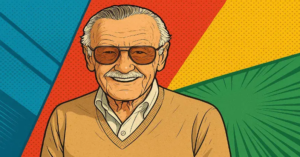
“Marvel Method” process:
- Lee outlines plot
- Artist (Kirby, Ditko) draws
- Lee adds dialogue
- Created iconic visuals like:
- Galactus saga (Fantastic Four #48)
- Psychedelic Doctor Strange (Ditko)
Stan Lee Controversy: Artists felt undervalued
“I figured if an adult read one of our comics and saw how literate they were, they’d be hooked.” —Stan Lee
1971 Spider-Man arc: Tackled drug abuse, defied Comics Code Authority, leading to policy reform.
Lee pioneered the “Marvel Method”: he’d outline a plot, artists like Kirby or Ditko would visually interpret it, and Lee add dialogue later. This collaborative engine fuelled unprecedented productivity but sowed tensions. Kirby’s dynamic cosmic vistas (e.g., Fantastic Four #48’s Galactus saga) and Ditko’s psychedelic Doctor Strange sequences were foundational, yet artists often felt under credited .
Lee also challenged industry censorship. In 1971, he published a Spider-Man arc addressing drug abuse—defying the Comics Code Authority—which sparked policy reforms. This paved the way for mature themes, cementing comics as legitimate social commentary.
🌪 Behind the Cape: Triumphs, Tragedies, and Betrayals
Lee’s ascent masked personal and professional storms. His wife Joan, whom he married in 1947, was his emotional anchor, yet his relentless work ethic strained family life. Financially, Marvel’s success rarely trickled down; Lee’s salary was modest until the 1970s when he became Publisher .
- Wife Joan: Married 1947, Lee’s emotional anchor
- Financial Struggles: Modest pay until 1970s
- Legal battles:
- 1998: Stan Lee Media—collapsed amid fraud
- 2002: Sued Marvel, won Spider-Man profits
- 2010s: Accused exploitation by managers
Despite setbacks: remained Marvel’s global ambassador
- Catchphrase: “Excelsior!”
- 2008: National Medal of Arts
Through it all, Lee remained Marvel’s ambassador—charming fans with his “Excelsior!” catchphrase and iconic cameos. His 2008 National Medal of Arts validated comics as cultural art.
🏛 Stan Lee Legacy: More Than Just Cameos
Lee’s final years were bittersweet. After Joan’s death in 2017, his health declined, yet he kept creating. He died in 2018, but his ethos endures:
🎬 Cultural Dominance
- MCU = $30+ billion global gross
- Lee = Highest-grossing figure in film history
✊ Social Advocacy
- Black Panther (1966): Pioneered Black representation
- 2018 film = Cultural landmark
🎓 Education
- Stan Lee Foundation (2009): Supported literacy and arts
🔍 Conclusion: The Man in the Mirror
Stan Lee’s brilliance wasn’t just creating heroes—it was revealing the hero within the ordinary. His characters’ flaws—Peter Parker’s insecurity, Tony Stark’s arrogance, the X-Men’s otherness—mirrored readers’ struggles. Lee transformed comics from escapist pulp into a mirror held up to society’s anxieties and aspirations.
His life, too, was a tapestry of contradictions: a literary aspirant who found immortality in panels; a collaborator embroiled in disputes; a titan battling personal demons. Yet through every twist, Lee championed hope. As he once declared: “Another mountain to climb? Another river to cross? That’s life. But as long as you’re passionate about what you do, you’ll never work a day in your life.”.
In a universe of gods and monsters, Stan Lee’s greatest superpower was making us believe we could be heroes too—one flawed, human step at a time. Excelsior!
Stan Lee’s brilliance wasn’t just creating heroes—it was revealing the hero within the ordinary.
- Peter Parker: Insecurity
- Tony Stark: Arrogance
- X-Men: Outsider identity
Comics = Mirror of society: Not just pulp, but emotional and social reflection
Lee’s own story:
- Literary aspirant turned comic legend
- Collaborator amid disputes
- Titan facing exploitation and aging
Yet he always championed hope:
“Another mountain to climb? Another river to cross? That’s life. But as long as you’re passionate about what you do, you’ll never work a day in your life.”
🌲 Visual Tree Structure of Article
Stan Lee’s Journey
├── The Making of a Mythmaker
│   └── Early life, education, first jobs
├── The Marvel Revolution
│   ├── Key Creations (1961–1966)
│   └── Humanizing Superheroes
├── The Marvel Method
│   ├── Collaborative approach
│   └── Artist tensions and censorship defiance
├── Behind the Cape
│   ├── Personal life
│   ├── Legal and financial battles
│   └── Public figure and honors
├── Legacy
│   ├── MCU impact
│   ├── Social advocacy
│   ├── Educational work
│   └── Major awards
└── Conclusion
    └── Human struggles, timeless inspiration
Annie Leibovitz: Capturing Icons, Defining an Era of Photography
Annie Leibovitz : Through the Photographer’s Eye

I. The Alchemy of Intimacy: Crafting Icons from Human Moments
Annie Leibovitz camera functions as both scalpel and paintbrush—dissecting the layered psychology of her subjects while composing visual symphonies that transcend time. When John Lennon curled naked around Yoko Ono on December 8, 1980, Leibovitz captured not just bodies but manifesto of love and vulnerability. Five hours later, Lennon’s assassination transformed that Polaroid into a cultural relic, proving her ability to freeze moments heavy with unspoken futures.
This alchemy defines Leibovitz’s 50-year reign as photography’s premier portraitist. Her lens dissected rock gods, royalty, and rebels, revealing their humanity through radical intimacy. “A thing you see in my pictures,” she reflects,“is that I was not afraid to fall in love with these people.” This emotional courage—paired with
painterly lighting and theatrical staging—redefined celebrity photography as psychological excavation.
II. Annie Leibovitz : From Military Bases to Rock ‘n’ Roll Frontlines (1949–1970)
Annie Leibovitz Early Influences
Born in Waterbury, Connecticut, in 1949,Anna-Lou Leibovitz inherited artistic curiosity from her modern-dancer mother and discipline from her Air Force lieutenant colonel father.Constant relocations—including a pivotal stint in the Philippines—taught her to observe cultures through the outsider’s lens. Her first camera, a
Minolta SRT101 bought in Japan, became her compass:“If I was going to live with this thing, I was going to have to think about what that meant.”
At the San Francisco Art Institute, Leibovitz abandoned painting for photography’s immediacy: “Photography took me outside and helped socialize me… I wanted reality.”Inspired by Robert Frank’s raw documentary style, she shot
anti-war protests—one image landing on a magazine cover, foreshadowing her career.
| Year | Event | Significance |
|---|---|---|
| 1967 | Enters San Francisco Art Institute | Shifts from painting to photography |
| 1969 | Works on kibbutz in Israel | Documents war protests; first published cover |
| 1970 | Hired by Rolling Stone | Shoots John Lennon; begins defining rock photography |
III. Annie Leibovitz Stone Era: Chasing the Zeitgeist (1970–1983)

Annie Leibovitz – The Crucible of Creativity
Rolling Stone became Leibovitz’s laboratory. At 23, she was named chief photographer, embedding herself with
counterculture icons. Her approach blended reportage with psychological portraiture.
- Unfiltered Access: She lived with The Rolling Stones for their 1975 tour, capturing backstage exhaustion and onstage frenzy. The hedonism cost her dearly—she battled cocaine addiction afterward.
- The Set-Up Portrait: Moving beyond candid shots, she staged conceptual images like Bette Middler nude on roses, merging vulnerability with artifice.
The Lennon-Ono session epitomized her method. When Yoko refused nudity, Leibovitz improvised: “Leave everything on.” The result—Lennon’s fetal embrace of Yoko—felt, in his words, “exactly like our relationship.”
IV. Annie Leibovitz : Theatrical Storytelling (1983–Present)
Annie Leibovitz Reinventing Glamour
Joining Vanity Fair’s relaunch, Leibovitz traded rock grit for high-gloss narrative: “I wanted to learn about glamour.” Her toolkit evolved:
- Cinematic Lighting: Mimicking Rembrandt’s chiaroscuro to sculpt subjects in dramatic shadows.
- Collaborative Ideation: Working with stylists and subjects to build elaborate tableaux, like Whoopi Goldberg submerged in milk—a visual metaphor for racial identity.
Annie Leibovitz Iconic Images
- Demi Moore, Pregnant (1991): Defying Vanity Fair’s request for a headshot, Leibovitz portrayed Moore nude and regal. The cover sparked outrage but dismantled taboos around pregnancy.
- Queen Elizabeth II (2007): Leibovitz stripped royal portraiture of pomp, capturing the Queen in tweed against misty moorlands. Palace tensions flared, but the image humanised monarchy.
- Caitlyn Jenner (2015): Jenner’s Vanity Fair reveal, shot in a corset and pearls, became a landmark in transgender visibility.
V. Annie Leibovitz Method: Intimacy as Technique
Anatomy of a Photoshoot
Leibovitz’s process is a masterclass in psychological orchestration:
- Pre-Shoot Immersion: Days researching subjects—reading their work, studying their gestures. For Louise Bourgeois, she visited the sculptor’s studio, capturing her gripping a marble “egg” like a talisman.
- Rapport Building: Hours of conversation precede the first click. “You must take care of people who open their hearts to you,” she insists.
- Technical Alchemy: Uses medium-format Hasselblads for depth, primes (50mm, 85mm) for intimacy, and mixes tungsten with natural light for painterly texture.
“I don’t think there’s such a thing as capturing the perfect moment… But you can capture raw moments that are honest.” — Annie Leibovitz
VI. Controversies & Challenges: The Cost of Authenticity
Leibovitz’s pursuit of truth often ignited firestorms:
- Miley Cyrus (2008): A 15-year-old Cyrus wrapped in satin provoked accusations of exploitation. Leibovitz defended it as “a simple, classic portrait.”
- LeBron James/Gisele Bündchen (2008): Critics saw racist tropes in the “King Kong”-inspired Vogue cover; others praised its subversion.
- Financial Struggles: Lavish productions led to near-bankruptcy in 2009, forcing her to mortgage her life’s work. Yet she continued creating, calling photography “a dance with light and weather.”
VII. Legacy: The Humanist with a Hasselblad
Leibovitz’s influence radiates beyond galleries:
- Cultural Archivist: Her images—from Nixon’s resignation to Obama’s presidency—document America’s psyche.
- Feminist Icon: Projects like Women (2003) celebrate female strength and complexity.
- Mentor & Educator: Teaching at Yale, she inspires the next generation of photographers.
VIII. Conclusion: The Eternal Dialogue Between Lens and Soul
Annie Leibovitz’s work is a dialogue—between artist and subject, light and shadow, the fleeting and eternal. She doesn’t just take pictures; she invites us into intimate moments that reveal our collective humanity. As she aptly puts it:
“Photography is a way of feeling, of touching, of loving. What you have caught on film is captured forever… it remembers little things, long after you have forgotten everything.”
Banksy: The Invisible Artist Who Speaks Loud
🌳 Structure Overview
Banksy: The Invisible Artist Who Speaks Loud
│
├── I. The Birth of a Phantom: Origins and Identity
│   ├── A. Bristol’s Unlikely Revolutionary
│   ├── B. The Name, The Myth
│   └── C. Identity Speculation: Red Herrings and Clues
│
├── II. Stencils as Subversion: Artistic Evolution
│   ├── A. Technique: Speed as Rebellion
│   ├── B. Exhibitionism as Critique
│   └── C. The Street as Canvas, The World as Audience
│
├── III. Anonymity: The Ultimate Performance Art
│   ├── A. Practicality and Power
│   └── B. The Art World’s Complicated Dance
│
├── IV. Activism: Art as a Weapon
│   ├── A. Humanitarian Provocations
│   └── B. The "Banksy Effect" on Communities
│
├── V. The Market vs. The Message
│   ├── A. Commercialization and Contradiction
│   └── B. Anonymity’s Economic Shield
│
└── VI. Legacy: The Invisible Revolution
The Paradox of Anonymity in a World Obsessed with Identity
In an era defined by digital footprints, celebrity culture, and relentless self-promotion, Banksy stands as a defiant anomaly—an artist whose face remains unknown while his voice echoes globally. His stenciled rats, satirical murals, and subversive installations have transformed urban landscapes into arenas of cultural critique, merging guerrilla tactics with poetic resonance. More than a graffiti artist, Banksy is a cultural philosopher armed with spray paint, leveraging invisibility as both shield and weapon. This exploration dissects the layers of his enigma, the evolution of his craft, and the seismic impact of an artist who proves identity is irrelevant when art speaks truth to power.
I. Banksy The Birth of a Phantom: Origins and Identity
A. Bristol’s Unlikely Revolutionary
Banksy emerged from Bristol’s underground scene in the early 1990s, a city pulsing with trip-hop beats and countercultural energy. Born likely in 1974 as Robin Gunningham (per Mail on Sunday’s investigation), he attended Bristol Cathedral School before expulsion and petty crime led to a formative prison stint. His early work with the DryBreadZ Crew (DBZ) featured freehand graffiti, but a near-arrest under a diesel-leaking truck became a creative epiphany: spotting a stenciled serial number, he realized stencils could slash production time and amplify impact.
B. The Name, The Myth
The alias “Banksy” evolved from “Robin Banx”—a nod to his early “robbing banks” edge—later streamlined for memorability. His first major mural, The Mild Mild West (1999), depicted a teddy bear hurling a Molotov cocktail at riot police in Stokes Croft, Bristol. It announced his signature blend of whimsy and dissent.
C. Identity Speculation: Red Herrings and Clues
Robin Gunningham: Geographic profiling by Queen Mary University linked Banksy’s works to Gunningham’s movements. A 2003 BBC interview caught Banksy confirming his first name as “Robbie”.
Robert Del Naja: The Massive Attack founder, a former graffiti artist, fueled theories by coordinating Banksy-like murals during tour dates. Del Naja denies being Banksy but calls him a “friend”.
Collective Theory: Some argue Banksy is an art collective—a notion amplified by the scale of projects like Dismaland.
Banksy’s own words dismiss the obsession: “I don’t want to take sides. I want to take over.”
II. Banksy Stencils as Subversion: Artistic Evolution
A. Banksy Technique: Speed as Rebellion
Banksy’s switch to stencils was pragmatic: “A tight image in 30 seconds is the way to go.” This efficiency let him target high-surveillance zones—police stations, war zones, museums—while embedding complex narratives:
Rats: Symbols of society’s “powerless losers,” they scrub floors, wield placards (“Welcome to Hell”), or loom over cities like anarchic giants.
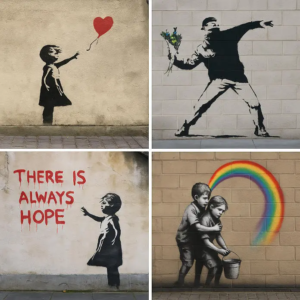
Children and Animals: Innocence weaponized. Girl with Balloon (2002) contrasts hope with loss; Napalm (2004) traps a Vietnamese war victim between Mickey Mouse and Ronald McDonald.
B. Banksy Exhibitionism as Critique
Banksy hijacked traditional art spaces to lampoon their elitism:
Turf War (2003): Live cows spray-painted with Warhol portraits; Queen Elizabeth as a chimp. Animal rights activists chained themselves in protest.
Crude Oils (2005): Monet’s water lilies polluted with shopping carts; 164 live rats infesting a London gallery.
Barely Legal (2006): An elephant painted in “poverty pattern” gold—a jab at inequality. L.A.’s elite partied beside it until authorities ordered the paint removed.
C. The Street as Canvas, The World as Audience
Banksy’s public installations force communal reckoning:
West Bank Wall (2005): Trompe l’oeil holes revealing beaches; a ladder ascending to freedom. Israel’s military called it “vandalism”; Palestinians protected the works.
Valentine’s Day Mascara (2023): A 1950s housewife with a black eye, swinging a man into a real freezer. Domestic violence charities used it to spark dialogue.
III. Anonymity: The Ultimate Performance Art
A. Banksy Practicality and Power
Banksy’s invisibility began as necessity—“graffiti is illegal”—but morphed into conceptual genius. It:
Democratizes Art: Viewers engage the message, not the myth. As he stated, “anonymity is vital because it stops your ego interfering.”
Fuels Mythmaking: A pizza box he discarded sold for $102 on eBay; DNA-laden anchovies became relics.
Enables Risk: Installing Crimewatch UK in Tate Britain required a disguise: floppy hat, scarf, and “fine art courier” confidence.
B. The Art World’s Complicated Dance
Galleries and auction houses profit from his anti-establishment brand:
Sotheby’s Shredding (2018): Girl with Balloon self-destructed post-sale, skyrocketing its value. Banksy filmed bystanders’ shock, captioning it, “The urge to destroy is also a creative urge.”
Market Irony: Works like Kissing Coppers ($575,000) critique authority yet fund the elite. Banksy retorted with a painting of auctioneers titled, “I can’t believe you morons actually buy this shit.”
IV. Banksy Activism: Art as a Weapon
Table: Banksy’s Anti-War Iconography
| Artwork | Symbolism | Context |
|---|---|---|
| CND Soldiers (2005) | Soldiers painting a peace sign | Protesting Iraq War/nuclear arms |
| Happy Choppers | Helicopters tied with pink bows | Militarization masked as “gifts” |
| Mediterranean Sea View (2017) | Migrant life vests as seascape | Refugee crisis; sold for £2.23M for charity |
| Borodyanka Mural (2022) | Gymnast balancing on rubble | Ukraine war resilience |
A. Humanitarian Provocations
Bethlehem’s Walled Off Hotel (2017): Rooms overlooking Israel’s separation wall featured “Pillow Fight” (soldier vs protester) and “Jesus with Sniper Dot.” Profits supported Palestinian artists. It closed in 2023 amid escalating violence.
Glastonbury Lifeboat (2024): Inflatable migrant boat dummies crowd-surfed during IDLES’ set—a silent indictment of U.K. refugee policy.
B. The “Banksy Effect” on Communities
When Banksy claims a wall, locals face chaos:
Margate (2023): Valentine’s Day Mascara drew media swarms. The council removed its attached fridge; fans stole the plastic chair.
Lowestoft (2021): Seagull Stealing Chips cost owners £450,000 in preservation fees. Gert, the landlord, fumed: “It’s not a seagull, it’s an albatross!”
V. The Market vs. The Message
A. Commercialization and Contradiction
Banksy’s Pest Control authenticates works but can’t control speculation:
Vandalism as Investment: Murals are chiseled from walls, like Slave Labour (2012), sold for $1.1M after vanishing from London.
Ethical Tensions: Dealer John Brandler notes, “The brand Banksy is so big, anonymity doesn’t matter anymore.” Yet purists like Steph Warren insist street art dies when removed: “Context is everything.”
B. Anonymity’s Economic Shield
By avoiding galleries, Banksy retains control:
Self-Published Books: Wall and Piece sold 250,000+ copies, funding projects sans intermediaries.
Unauthorized Sales: eBay listings of “Banksy dirt” or shredded canvas fragments parody art commodification.
VI. Legacy: The Invisible Revolution
Banksy redefined art’s relationship with power:
Democratizing Access: “You don’t need college or to sleep with someone powerful. Just ideas and broadband.”
Inspiring Global Movements: Ukraine’s “Sharik” and Russia’s anti-war graffiti adopt his stencil style.
Enduring Questions: Does anonymity amplify art’s purity? Or does removing the artist neuter accountability?
In 2024, as his wildlife murals surface in London—a satellite-dish wolf, a car-crushing rhino—the cycle continues: creation, defacement, myth. Banksy remains a cultural paradox: a silent voice that deafens, a ghost haunting capitalism’s machine, and proof that in a world screaming for attention, sometimes the loudest statement is made unseen.
“Art should comfort the disturbed and disturb the comfortable.”
— Banksy’s uncredited manifesto, lived in every stroke.
Zaha Hadid architecture design
Zaha Hadid: Shattering Architecture’s Glass Ceiling

Introduction
Zaha Hadid was a force of nature in the field of architecture, a woman whose visionary sensibility and formidable personality have reshaped skylines and redrawn the boundaries of buildings. Born in Baghdad in 1950, she rose to prominence in a profession long men dominated and was for award- the Pritzker Architecture Prize in 2004, the first woman to receive it. This blog explores her extraordinary life, her pioneering contributions, and the lasting impact she made.
Early Life and Education
The Formative Years
Zaha Hadid came from an illustrious family in Iraq. Her father, Mohammed Hadid, was a powerful politician and industrialist, and her mother, an artist. With her liberal, intellectual upbringing, Hadid got expose to multiple fields and thoughts. She spent much of her childhood traveling and attending Catholic schools in Iraq and Switzerland, forging a global perspective early in life.
Architect with the interest in :Architecture Studies in London
Zaha Hadid arrived in London in the 1970s to study at the Architectural Association School of Architecture. It was a transformative time at the AA. Under the influence of avant-garde architects Rem Koolhaas and Elia Zenghelis, Hadid developed an audacious, experimental style. Her thesis project, “Malevich’s Tektonik”, was an homage to the Russian Constructivists and a hint of her work to come — straying into radical geometry and abstraction while incorporating movement.
An Early And Difficult Career
Establishing Her Own Firm
In 1980, Hadid established her own London based architecture office, Zaha Hadid Architects (ZHA). The firm confronted various obstacles, not the least of which was the reluctance of the architectural world to accept a female-led practice whose designs were highly conceptual. Many of her early commissions went unbuilt, leading to her being known as a “paper architect.”
The Turning Point
Architectural breakthrough For Hadid, that building got completion in 1993, the Vitra Fire Station in Weil am Rhein, Germany. It was small in scope, but was a step toward converting her abstract images into reality. A sculptural composition of sharp angles and dynamic planes, it heralded Hadid’s move from idea to building.
Breaking Through: Major Works
MAXXI Museum, Rome
Hadid’s fluid architectural vocabulary made in projects like the MAXXI – Museum of 21st Century Arts in Rome, which was completed in 2009. The building blurs the distinctions between inside and outside, a meandering concrete shape with intersecting pathways that invites exploration and interaction. It won the Stirling Prize in 2010.
Guangzhou Opera House
Twin pebbles on the riverbank is how the Chinese Guangzhou Opera House, which opened in 2010 and described. Its form and geometry serves to improve acoustics and enable an engaging spectator experience, weaving within the urban framework of the city. It became a symbol for China’s cultural aspirations.
London Aquatics Centre
It is perhaps her best known public work in the UK and known to built for the 2012 Olympic Games, the London Aquatics Centre. The roof’s cascading curves are meant to create the sensation of the movement of water, a fitting metaphor for the mission of the building. The design was loud for its architectural and operational efficiency.
Other Notable Projects
Heydar Aliyev Center (Baku, Azerbaijan)
The building’s undulating, wave-like design has made it a tour de force of contemporary architecture.
Dongdaemun Design Plaza (Seoul, South Korea)
A futuristic urban development designed for public space, retail and exhibition.
Galaxy SOHO (Beijing)
A commercial structure of interlocking, fluid forms, and a clear demonstration of Hadid’s philosophy regarding fluidity of space.
Overcoming the Gender Barrier

A Male-Dominated Field
Architecture has always been a boys club. While women in architectural education were on the rise, the same could not be said for leadership and prestigious commissions. Hadid’s ascent was itself an affront to those norms.
Paving the Way for Others
In 2004, her being awarded the Pritzker Prize was a watershed not just for her career but for women in architecture in general. Hadid frequently described her hardships as a woman for being from the Middle East in a male and Western-dominated field. She is the one of the woman architects who encouraged a whole lot of other women to take-up architecture with their heads up high.
Philosophy and Design Ethos
Deconstructivism and Fluidity
Hadid’s work has been deemed deconstructivist, referring to a type of design that scorns traditional rectilinear forms. Her buildings are dynamic, fluid, and appear to be in motion. She spurned the orthodoxy of the grid and embraced a visual language that valued complexity.
The Role of Technology
In the vanguard in its use of digital technology, Hadid’s firm employed advanced computer modeling to achieve its sinuous forms. Her parametric designs gave rise to buildings with nature-inspired shapes and structural behaviors never seen before, revolutionizing the field of engineering and construction methods.
Art, Mathematics, and Nature
Her influences were many and varied: Russian Suprematism, Islamic calligraphy, natural topographies, mathematical patterns. Her work frequently has the look of formations in nature — rivers, dunes and coral reefs — but is determinedly future-forward.
Legacy and Influence
Awards and Accolades
Zaha Hadid’s honors include:
- Pritzker Architecture Prize (2004)
- Stirling Prize (2010, 2011)
- RIBA Gold Medal (2016) – the first woman to win it on her own.
- Dame Commander of the Order of the British Empire (DBE) Honour given for services to international development, overseas exports, and charity causes.
Continued Impact Through ZHA
Zaha Hadid Architects has furthered her legacy since she died in 2016. Under the guidance of Patrik Schumacher the office continues to be a leading protagonist in designing and technology. Recent projects include the Beijing Daxing International Airport and the Al Wakrah Stadium in Qatar.
Impact on Modern Architecture
Her influence spreads beyond her constructed work. She was instrumental in redefining architectural education and theory, and in teaching architects to subvert constraints and upend orthodoxy. Xenophobia Her message is still relevant in advocating for diversity in architecture.
Criticism and Controversy
Design Practicality
Some critics said Hadid’s designs were more about visual excitement than utility. Complex shapes could also result in higher costs and construction difficulties sometimes prevailed. But a lot of her designs have been praised for how well they work after everything is finished.
Labor and Ethics
Hadid also came under scrutiny for accepting work in areas with controversial labor practices, particularly the Gulf. In her own defense, she traced the balance of power between developers and local government, underscoring how little control architects can have over labor conditions.
Personal Life
A Complex Persona
Zaha Hadid had a forceful personality; she was often described as uncompromising and assertive. With high standards and relentless drive, she was both admired and criticized. But closer acquaintances also describe her as warm, funny, loyal.
Artistic Pursuits
Alongside architecture, Hadid also worked on furniture, jewellery and fashion. Her partnership with Chanel, Louis Vuitton and Swarovski were some of her projects fine art collaborations. They were part of her conviction in art and design as fundamentally unified, irrespective of the scale of the work or the discipline.
Conclusion
A Lasting Legacy
Zaha Hadid’s life and output are a testament to the ambition that vision needs to be met with. She made architecture into an art that soars beyond the expected, cheered complexity, movement and, above all, inclusivity. Her legacy is still evident in the world in which we live.
Inspire Future Generations
Hadid’s influence extends well beyond her buildings. She encouraged a generation of architects, especially women and minorities, to take on the establishment. She is a shining light for creative spirit, daring and change.
References and Additional Reading
[1] S. Boztug, V. Reichenberger and J.C. Willems, A note on feedback stabilization for non-square systems Systems Control Lett.
Books
- ‘Zaha Hadid: Complete Works,’ by Aaron Betsky
- Zaha Hadid Architects: Redefining Architecture and Design, by Zaha Hadid Architects
Articles
- Architectural Digest: “Zaha Hadid’s Most Iconic Buildings”
- Dezeen: “The Riches of Zaha Hadid”
Documentaries
- “Zaha Hadid: Who Dares Wins” (BBC Documentary)